
What goes into a route-ready mobile dog grooming van: generator sizing, water systems, HVAC, noise targets, and the spec choices that decide whether the route works.
What’s actually in a route-ready mobile grooming van
Yorkie named Pepper came on the van in October. Owner mentioned, casually, that Pepper had been scratching her ears a little. I lifted the right flap. Inside: dark waxy buildup, a smell I won’t describe, and skin that was raw at the canal. We didn’t groom that day.
I called the vet practice across the street, sent a photo, Pepper walked in for an exam at 11am. Sometimes the highest-value thing the van does isn’t the haircut. It’s the noticing. None of that is possible without the van itself working right.
A working mobile grooming van has to deliver three things at once: enough power to run a high-velocity dryer plus a heater, enough water to do four to six dogs without refilling, and enough quiet that the dog will actually let you finish the groom. None of those are negotiable. Skip on one and the route stops working.
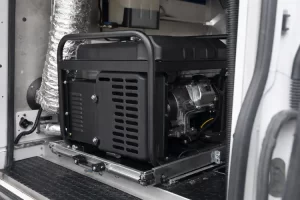
Generators: kW sizing and the cold-morning trip
A mobile grooming van pulls 18 to 24 amps when the dryer and the heater are both running. Which is why generator sizing matters. Most route-ready vans are spec’d with a 7.5 or 10 kW unit.
Anything smaller and you’ll trip on cold mornings when the heater spikes. I run 10 kW on every van, and on the coldest morning of the year I’m still glad I did.
| Generator | Continuous load | Best for | What it can’t do |
|---|---|---|---|
| 5.5 kW | ~22 amps continuous | Single-dog days, warm-weather operations | Dryer + heater simultaneously |
| 7.5 kW | ~31 amps continuous | Most year-round US routes | Heavy double-coat days with auxiliary heat |
| 10 kW | ~41 amps continuous | Cold-climate routes, larger dryers | Nothing you’d hit in normal use |
| Battery + inverter (no fuel) | Variable, 30-50 amps peak | Quiet residential routes, half-day use | Full-day routes without a charge break |
Battery-electric setups are catching on fast and they’re real. The newer LiFePO4 systems give you a quiet driveway and no fuel runs.
The downside: a busy 5-dog day with a high-velocity dryer pulls battery faster than the marketing says, and a charge break in the middle of the route kills your throughput. Hybrid (battery for stops 1 to 3, generator after) is the practical middle ground in 2026.
Water systems: fresh tank, gray tank, and the 35-gallon route
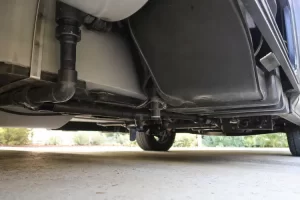
Water side: 30 to 60 gallons fresh, 30 to 60 gray, depending on box. A four-dog route burns roughly 35 gallons. The math runs out faster than you think on a heavy double-coat day, when you’re rinsing twice and using a deshedding spray. Plan for the bad day, not the average day.
- Fresh tank: 50 gallons minimum for a route-ready van. Smaller tanks force a midday refill, and the closest hose isn’t always cooperative.
- Gray tank: equal or larger than the fresh tank. Many counties tax overflow into landscape drains. Don’t risk it.
- Water heater: 6 gallons tank-style or a tankless propane unit. Tankless is more flexible but pickier about pressure. Tank-style is forgiving and breaks less.
- Booster pump rated for 45 PSI. Below that and the spray nozzle feels limp on a bigger dog.
- A clear sight tube on both tanks so you know without guessing. Saves arguments mid-route.
HVAC and noise: why 65 dB matters more than 72
Most dogs tolerate up to roughly 65 decibels of ambient noise without noticeable stress. Above 72 you start to see panting, panting that turns into refusing the table, and refusing the table that ends the groom early.
The van’s internal noise floor (generator behind the bulkhead, HVAC fan, dryer at idle) sets the baseline. Get the generator soundproofing right, mount the dryer with vibration isolators, and add an acoustic blanket on the bulkhead. Easy upgrade. Pays back in dog after dog.
HVAC: the van needs to hold 68 to 74 degrees year-round inside the bay. Dogs heat up under the dryer, you cool the bay. The dog is comfortable, the groom finishes on time, the next dog walks in calm.
The cheap mistake is undersizing the HVAC for the bay’s volume. A standard 12-foot box wants a 12,000 BTU system minimum, ducted through the ceiling. More if your route is in Phoenix or Tampa.
Build new vs. refurbish: the decision behind the spec
New chassis with a new box is the cleanest path. Lower maintenance overhead in the early years, predictable downtime, a warranty that covers the box for the period the manufacturer stands behind it.
The trade-off is lead time. A custom buildout from a known box manufacturer often runs three to five months from order to delivery, and the spec sheet is locked early in that window.
Refurbished paths come in two flavors. A used chassis with a fresh box gives you the new buildout faster and lets you put more attention into the things that matter inside the van.
A used chassis with a refurbished box gets you on the road quickest but compresses your maintenance schedule, because the chassis and the box reach mid-life service events at the same time.
The right path depends less on what is available and more on how much unplanned downtime your operating model can absorb. A single-van independent should weight reliability heavily. A multi-van operator with a service rotation can run a refurbished van without disrupting the route.
- New chassis + new box. Lowest unplanned downtime. Longest lead time. Best fit for first-time owners building one van and committing to a long-term operating model.
- Used chassis + new box. Faster on the road. Mid-life chassis service event in year three to four. Best fit for operators with a backup van or a mature dispatch system.
- Used chassis + refurbed box. Fastest on the road. Compressed maintenance window. Best fit for multi-van operators who already have a service rotation built.
Maintenance: what breaks and when
- Months 1-12: Pump seals and water heater hoses. Cheap fixes but they will happen.
- Year 2: Generator service. Spark plugs, oil, air filter. Annual cadence regardless of hours.
- Year 2-3: Dryer motor brushes wear. A high-velocity dryer needs a brush replacement every 18 to 24 months at full-route use.
- Year 3: AC compressor on the chassis. The first big repair if you catch it before it fails.
- Year 4-5: Tank flush and replumbing. Calcium buildup affects pressure. Budget a weekend.
Speccing your first van this quarter?
If you’re shopping vans, talk to two operators who run the same chassis you’re considering before you put money down. The honest review of a working operator beats every brochure.
Ask the Kontota franchise team for a tour of a current van; the spec choices we made are documented in the franchise FAQ and on the support pages. The right van isn’t always the most expensive one. It’s the one that fits your route, your climate, and the kind of day you want to come home to at six o’clock.
For the people side of running these vans, the retention systems behind keeping top mobile groomers is the next post I’d read. The van is the easy part. The groomer in the van is the harder, more interesting one.

