Franchise or go solo? Here’s what a mobile dog grooming franchise actually costs vs. an independent startup over five years, including royalties, training, and ramp-up time.
The franchise vs. independent question is where a lot of aspiring grooming business owners get stuck. The pitch for going solo sounds appealing: no royalties, more flexibility, keep everything you earn. The pitch for a franchise sounds appealing too: training, brand, built-in systems. Neither pitch tells you what the numbers look like at year three or five. Here’s a straight look at what each path actually costs and produces across a five-year horizon.
Quick take: The franchise path typically costs $30,000 to $60,000 more at launch. By year three, strong operators under both models tend to produce similar net income. By year five, the franchise advantage shows up in resale value and scalability, not in monthly cash flow.
Startup Cost Comparison: Franchise vs. Solo Startup
Going independent costs less on day one. You’re buying a van and equipping it yourself, which runs $65,000 to $90,000 if you source carefully. No franchise fee. No royalty structure. You keep the full ticket. The tradeoff is you’re building every system from scratch: booking, pricing, scheduling, client communication, handling complaints, and figuring out the grooming protocols that work for your market.
| Launch Cost Category | Independent | Franchise |
|---|---|---|
| Franchise fee | $0 | $20,000 to $40,000 |
| Van and equipment | $65,000 to $90,000 | $68,000 to $95,000 |
| Training (external, independent) | $2,000 to $5,000 | Included |
| Booking/scheduling software | $1,200 to $2,400/yr | Often included |
| Marketing setup (website, ads) | $2,500 to $6,000 | Reduced to $500 to $2,000 |
| Opening inventory | $800 to $1,200 | $800 to $1,200 |
| Working capital | $20,000 to $40,000 | $20,000 to $40,000 |
| Estimated total launch | $91,500 to $144,600 | $110,300 to $179,200 |
The gap is real, roughly $20,000 to $35,000 more on the franchise side. Whether that gap closes over five years depends entirely on how fast the franchise systems get you to profitability versus how long it takes a solo operator to build equivalent systems.
Training and Ramp-Up: How Quickly Each Path Generates Income
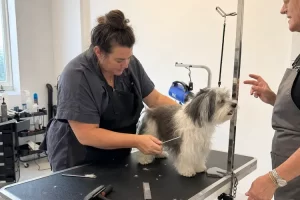
Most franchise systems offer 1 to 2 weeks of initial training, covering grooming technique, van operation, booking protocol, and brand standards. Some add a field training component where you work alongside an experienced franchisee for a week or two. That’s the advantage: a structured ramp that gets you to a bookable product faster than figuring it out alone.
Going independent, you’re responsible for training yourself or hiring someone who already knows what they’re doing. If you’re already an experienced groomer, the training gap is smaller. If you’re new to grooming, self-training or attending a grooming school runs $2,000 to $6,000 and takes 3 to 6 months before you’re producing at a bookable standard. The ramp-up cost difference between franchise and independent depends almost entirely on your baseline grooming experience.
Customer Acquisition: Brand vs. Building From Scratch
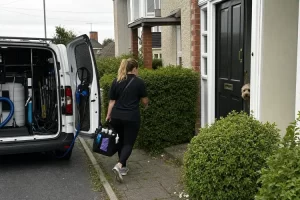
Here’s a thing most franchise sales people won’t say out loud: in a new territory, you’re starting from zero either way. The franchise brand helps with credibility and search visibility in markets where the brand is already known. In a new market where the brand isn’t established, you’re doing the same grassroots customer acquisition work a solo operator does: yard signs, Nextdoor posts, referral programs, Google Business profiles.
The solo path is harder on marketing infrastructure because you’re building it yourself, not inheriting it. But the marketing cost delta isn’t huge. I’ve seen solo operators get to 30 regular clients faster than some franchise operators in the same time window, because they were more aggressive on local social media and priced themselves as a referral play in month one. Brand helps. It doesn’t replace hustle.
Royalty Math Over a Five-Year Horizon
Royalties are the core financial argument against franchising. At 6 to 8 percent of gross revenue, plus 1 to 3 percent for brand fund, you’re paying 7 to 11 percent of every dollar you earn to the franchise system. At $10,000 monthly gross, that’s $700 to $1,100 per month. Over five years at median growth, you’re looking at $50,000 to $80,000 paid out in royalties. That’s a real number.
The question is what you’re getting for it. If the franchise system’s booking software, operational support, brand equity, and training saved you 6 to 12 months of ramp-up time, the royalty math can be positive. If the system’s support is thin and you had to build most things yourself anyway, you paid a large premium for a logo and a territory map. This is why talking to current franchisees across multiple systems matters before you commit.
What the Numbers Say About Which Path Works
- Choose franchise if: you’re new to the industry, want a structured launch, and value the reduced decision-making load in year one
- Choose independent if: you’re an experienced groomer, have existing clients or referral networks, and want to keep 100% of revenue from day one
- The royalty premium only pays back if the franchise system genuinely accelerates your ramp: ask franchisees exactly how long it took to reach break-even
If the franchise path makes more sense for your situation, understanding our mission and philosophy at Kontota is a good starting point before digging into the numbers. And if you want to run the five-year pro forma for your specific market, book a discovery call and we’ll work through the actual unit economics for your territory.