
What does cash flow actually look like when you scale a mobile grooming franchise? Here’s the operational and financial reality from one van through three, with real margin data.
Going from one van to two is not adding a van. It’s changing the job. Most mobile grooming franchise operators figure this out too late, when they’re six weeks into running two vans and wondering why their margin is lower than it was on one. Here’s what the cash flow actually looks like at each stage and what the operators who scale successfully do differently.
When One Van Is Profitable Enough to Add a Second
The trigger most experienced multi-unit operators point to: when your single van is running at 85 to 90 percent of booking capacity for at least 8 consecutive weeks, you’re ready to think about a second. Not when it feels busy. When the calendar data says it’s consistently full. If you’re booking 6 to 7 appointments per day, 5 days a week, and turning away or delaying clients, that’s your signal. If you’re still getting to 6 only on your best weeks, you’re not ready. Adding overhead before revenue justifies it is how operators get stuck.
I waited until month 14 before adding my second van. The franchise system said I could probably do it at month 9 based on my numbers. I’m glad I waited. Month 9, my rebook was at 58 percent. Month 14, it was 71. That difference meant the second van was starting into a territory where the first van had already built brand recognition, and a percentage of clients were actively waiting to hear about the new van so they could switch to a more convenient slot. That’s a very different setup than launching cold.
The Operational Complexity That Scales Faster Than Revenue

Here’s what nobody tells you clearly before you scale: one van means you are the dispatcher. You know where every appointment is, what the dog’s coat looks like, whether the owner wants a bandana or not. You hold all of it in your head. Two vans means you’re managing someone else’s day from a distance. Route changes, client reschedules, equipment issues, a dog who’s matted worse than the notes said. You’re handling those via text while you’re still in someone’s driveway finishing your own appointment.
The operators who get through this phase have one thing in common: they set up their dispatch system before they add the second van, not after. That means a shared booking calendar, a clear call and communication protocol for issues, a pricing and tips policy the hired groomer knows cold, and a daily check-in time. Fifteen minutes at the start and end of each day, every day, for the first 60 days with a new van. That’s the operational difference between a smooth scale and three months of chaos.
Dispatch, Scheduling, and Routing at Multi-Van Scale
Route efficiency matters even more with two vans than one. With one van, an inefficient route costs you one appointment per day. With two vans, an inefficient route on both costs you two appointments and double the fuel. Before you launch the second van, spend two weeks building out the routing for your territory as a two-van operation. Divide the territory into clusters. Assign each van a primary zone for the week, with enough overlap to handle schedule changes without long repositioning drives.
- Divide the territory into 2 routing zones before the second van launches
- Assign each groomer a home zone with a defined starting neighborhood each morning
- Build a cross-zone buffer of 3 to 4 appointments per week that can flex between vans
- Track drive time per appointment on both vans weekly for the first 90 days
- Set a fuel cost per groom target and review it monthly
Financial Structure at Three Vans: What the P&L Actually Looks Like
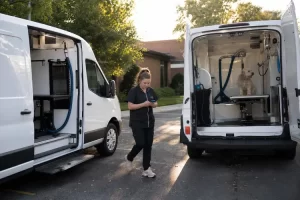
Three vans is the point where the business starts to look like a real operation instead of a self-employment situation. My books at three vans, at the 30-month mark: labor at 42 percent of revenue, royalty and brand fund at 8 percent, van costs (insurance, fuel, maintenance, payments) at 18 percent, supplies at 4 percent. That leaves about 28 percent as gross margin before my own compensation. On $28,000 monthly gross across three vans, that’s roughly $7,800 per month before I pay myself. Not rich. But it’s a real business with real employees and a real route, and I’m not the one holding the clippers every day.
The jump from two to three vans requires the same patience as one to two. Don’t add the third van until the second van is running at 85 percent capacity consistently. And when you do add it, hire the groomer first, run them on your existing vans for 3 to 4 weeks, and then commission the third van once you’ve verified they can hold a full route.
What Separates Operators Who Scale From Those Who Plateau at One Van
Scaling isn’t about ambition. Operators who want to grow and operators who actually do it aren’t different in how much they want it. They’re different in how they handle the three months of cash compression that follow each new van. The ones who plateau usually pull back at the wrong moment, when margin is thin and the new groomer is still building their route. They read the monthly numbers wrong and decide the second van was a mistake. It almost never is. It’s just a ramp, and the ramp takes longer than the math says it should.
The detail that separates them: the operators who scale have the working capital reserve to weather the ramp without making decisions from fear. They also tend to have better client communication, a stronger rebook process, and a way to hand off complaints without it landing on them personally. Those aren’t franchise-specific skills. But franchise systems that build them into the training process from day one give their operators a material advantage.
If you want to understand how franchise support is structured at Kontota through each growth stage, including what the multi-van operator support looks like, that’s a conversation worth having. And if you’re at or near the single-van stage and thinking about what the full growth path looks like for your territory, book a discovery call to run the numbers together.