
The franchise fee is just the start. Here’s what a mobile pet grooming franchise actually costs, from van and equipment to working capital and monthly overhead.
Most people looking at a mobile pet grooming franchise get stuck on the franchise fee. It shows up first in the sales deck, it’s the number that gets negotiated, and it feels like the main financial decision. It’s not. The franchise fee is the admission price. Here’s what the full investment actually looks like once you add everything that makes the business work.
Quick answer: Franchise fees for mobile pet grooming typically run $20,000 to $40,000. The full investment, once you factor in the van, equipment, working capital, and first-year costs, lands between $90,000 and $150,000. Understanding both numbers before you sign is the difference between a sustainable launch and running out of cash in month four.
The Franchise Fee Is the Wrong Number to Focus On
Every franchise has a fee. For mobile pet grooming, you’re usually looking at $20,000 to $40,000, depending on the system and the territory size. That money buys you the license, the brand, the training program, and access to the operational playbook.
It does not buy you a van, tools, insurance, or the cash cushion you’ll need while your route builds. Buyers who treat the franchise fee as the main negotiating lever tend to under-capitalize the business. Running out of capital by month four because you optimized the admission price is a painful lesson. I’ve watched it play out more than once.
The better question is: what does the total initial investment actually require? That’s where the unit economics start making sense, or stop making sense, for your situation.
Van and Equipment: What the Spec Sheet Doesn’t Include
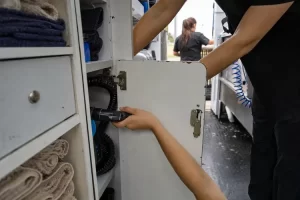
A fully outfitted mobile grooming van costs $68,000 to $95,000. That covers the box build, the grooming tub, water heater, battery or generator system, dryers, and the table.What most Item 7 disclosures don’t spell out clearly: opening supply inventory ($800 to $1,200 for shampoos, conditioners, and disposables), uniforms, business licensing and permits ($400 to $1,500 depending on your state and city), and the first year of commercial insurance ($1,800 to $3,500). Some of those costs vary a lot by territory.A franchise selling in rural Montana and urban Chicago will have very different licensing costs. Read the footnotes in the FDD before assuming the headline number covers everything.
| Cost Item | Low Estimate | High Estimate |
|---|---|---|
| Franchise fee | $20,000 | $40,000 |
| Van and equipment build | $68,000 | $95,000 |
| Opening supply inventory | $800 | $1,200 |
| Business insurance (year 1) | $1,800 | $3,500 |
| Licensing and permits | $400 | $1,500 |
| Vehicle insurance (first quarter) | $1,200 | $2,400 |
| Training travel and lodging | $600 | $1,500 |
| Total before working capital | $92,800 | $145,100 |
Working Capital: The Buffer Most First-Timers Skip
Working capital is the money that covers your personal expenses and business overhead while revenue ramps up. Most franchise systems recommend 3 to 6 months of personal living costs as a buffer. That range is undercooked for this business model.
A new mobile grooming territory takes 4 to 6 months to build consistent weekly revenue, especially if you’re starting cold with no inherited customer base. Hold 6 months of personal expenses plus 3 months of fixed business costs before you take your first booking.
- Personal living expenses (rent, groceries, utilities)
- Monthly royalty payments (5 to 8% of gross revenue)
- Brand fund contribution (1 to 3% of gross)
- Vehicle payment or lease if financed
- Fuel and van maintenance
- Supplies and product replenishment
- Health insurance (you’re self-employed now)
- Any local advertising costs at launch
Most buyers short this number by 30 to 40 percent. The first two months will generate less revenue than you planned. That’s not a sign the business isn’t working.It’s how route density builds. You need the cushion so you don’t start panic-booking unprofitable appointments just to cover expenses. That part surprises people. They think less revenue means something’s wrong. It usually just means the calendar hasn’t filled yet.
Monthly Costs Once You’re Operating

Once you’re running, fixed costs don’t disappear. They become your baseline. Here’s what a typical single-van operation carries every month.
| Monthly Expense | Typical Range |
|---|---|
| Royalty (6% on $10K gross) | $600 |
| Brand fund (2% of gross) | $200 |
| Van insurance | $400 to $550 |
| Fuel | $300 to $600 |
| Supplies and product restock | $200 to $400 |
| Vehicle payment (if financed) | $900 to $1,400 |
| Monthly total | $2,600 to $3,750 |
Revenue at month six for a healthy single-van operation tends to run $7,000 to $12,000 gross per month. At $7,000, margins are thin. At $12,000, you’re comfortable. The difference comes down almost entirely to rebook rate. Getting clients to rebook without a reminder is the lever. When rebook hits 60 percent, the monthly cash picture changes fast.
What Break-Even Actually Looks Like
Break-even isn’t a single month. It’s a threshold you cross gradually. Months 1 and 2 are typically unprofitable, with most revenue going toward operating costs and working capital drawdown. Months 3 and 4 tend to land around break-even on operating expenses. Month 5 or 6 is when most operators start producing a consistent surplus over what the business costs to run.
Paying back the full initial investment, including working capital, takes most single-van operators 3 to 4 years. Top performers, with strong route density and rebook above 65 percent, do it in 2 to 2.5 years.
If you’re trying to understand the Kontota franchise model in context of these numbers, that’s worth doing early. The specifics around territory size, van spec, and royalty structure all affect your particular math.
When you’re ready to run your own numbers against real territory data, book a discovery call with the team. Those conversations are designed to give you the specific numbers for your area, not just the broad ranges in this post.
The franchise fee matters. But the working capital cushion and the monthly cost structure are what determine whether you’re still in business 18 months from now. Build the full model before you decide. And make sure the working capital number you’re holding isn’t the minimum you could get away with. It should be the one that gives you room to build without panic.