
A mobile dog grooming franchise is not simply a van with grooming equipment. It is a coordinated business system that turns local demand into scheduled service. People, technology, territory planning, and safety procedures support that system. For an investor, understanding the system is as important as reviewing the brand, the market, and the financial disclosures.
Book a no-pressure franchise discovery call.
Pet grooming franchise business operations include recruiting and managing trained groomers, coordinating mobile units, scheduling appointments, communicating with customers, maintaining equipment, tracking performance, and building recurring local relationships. The franchise owner may lead day-to-day operations or develop an Operations Manager pathway, but remains accountable for the business system and customer experience.
That distinction matters for investors who do not have grooming experience. Kontota’s model is designed for entrepreneurs who can lead teams, follow operating standards, and make disciplined decisions while trained professionals deliver the hands-on service. The opportunity is business ownership in a specialized service category, not a requirement to become a professional groomer.
To evaluate the opportunity realistically, start by looking at what the operating model requires each day. Consider how the owner creates consistency. Then identify which questions belong in formal due diligence.
What Pet Grooming Franchise Business Operations Include
Pet grooming franchise business operations combine people, vehicles, scheduling, customer care, territory planning, and financial controls. The owner coordinates those parts through a repeatable system so trained groomers can deliver safe, consistent service in a defined local market.
For an investor, pet grooming franchise business operations means the coordinated system that turns a mobile grooming concept into a functioning local business. It includes staffing, scheduling, customer relationships, territory management, vehicle readiness, safety procedures, and financial oversight. The franchise owner is not simply purchasing a van or a service brand. The owner is building and managing an operating system that delivers a consistent customer experience.
That distinction matters because the owner’s role does not have to be hands-on grooming. No grooming experience is required for the Kontota opportunity. Franchisees can hire trained groomers and focus on leadership, recruiting, local business development, customer service, standards, and performance management. The work is still active and accountable. Someone must make sure the team is properly supported, appointments are fulfilled, customers receive clear communication, and the business follows its safety-first culture.
A recurring local customer relationship
Mobile grooming is designed around convenience for the pet owner and continuity for the business. Customers may schedule recurring appointments instead of treating grooming as a one-time transaction. That creates an operating priority beyond completing each service. The owner and team must deliver reliable communication, punctuality, pet handling, and follow-up that encourage customers to remain on the schedule.
Kontota positions this as a recurring-revenue model. Candidates should evaluate actual financial terms and disclosures in the current Franchise Disclosure Document rather than treat recurring appointments as a promise of results. Retention is earned through consistent service, not assumed because a customer booked once.
A mobile, home-based business structure
The mobile format changes how the business uses physical space. The operation can be managed from a home-based, low-overhead structure while groomers travel to customers in service vans. Kontota’s operating context includes battery-powered vans, which support quieter residential operations without relying on a traditional gas generator.
The owner must still plan for vehicle readiness, maintenance, supplies, insurance, staffing, and route efficiency. Low overhead does not mean no operating costs. Protected territory gives the franchisee a defined local market to develop, serve, and understand. An owner may pursue a full-time or semi-absentee structure through an Operations Manager pathway, but both models require oversight.
How Pet Grooming Franchise Business Operations Build a Safe Team
Owners create dependable service by hiring qualified groomers, setting clear operating expectations, coaching the team, and making safety visible in every routine. The owner can delegate hands-on grooming, but cannot delegate accountability for staff performance, customer trust, or brand standards.
A mobile grooming business depends on more than a well-equipped van. It depends on people who can deliver consistent care, communicate clearly with clients, and follow operating standards that protect pets, staff, and the brand. For that reason, the franchise owner does not need to be the person holding the clippers. No grooming experience is required. The owner’s job is to build and lead a capable team, then create the conditions for that team to perform well.
Hiring and developing the right team
Owners can hire trained groomers to perform the hands-on service while they focus on the business. That includes recruiting, onboarding, scheduling, coaching, and reviewing service quality. An owner-operator may stay closely involved in daily activity, while an owner pursuing a semi-absentee model can develop an Operations Manager to oversee day-to-day execution. Either approach requires active leadership. Delegating grooming is not the same as stepping away from the business.
Strong people management starts with clear expectations. Owners should define how appointments are prepared, how pets and owners are welcomed, how concerns are escalated, and how service issues are resolved. Regular check-ins and practical coaching help turn those expectations into repeatable habits. The goal is a dependable client experience across every groomer and every visit, not reliance on one individual employee.
Making safety part of the operating system
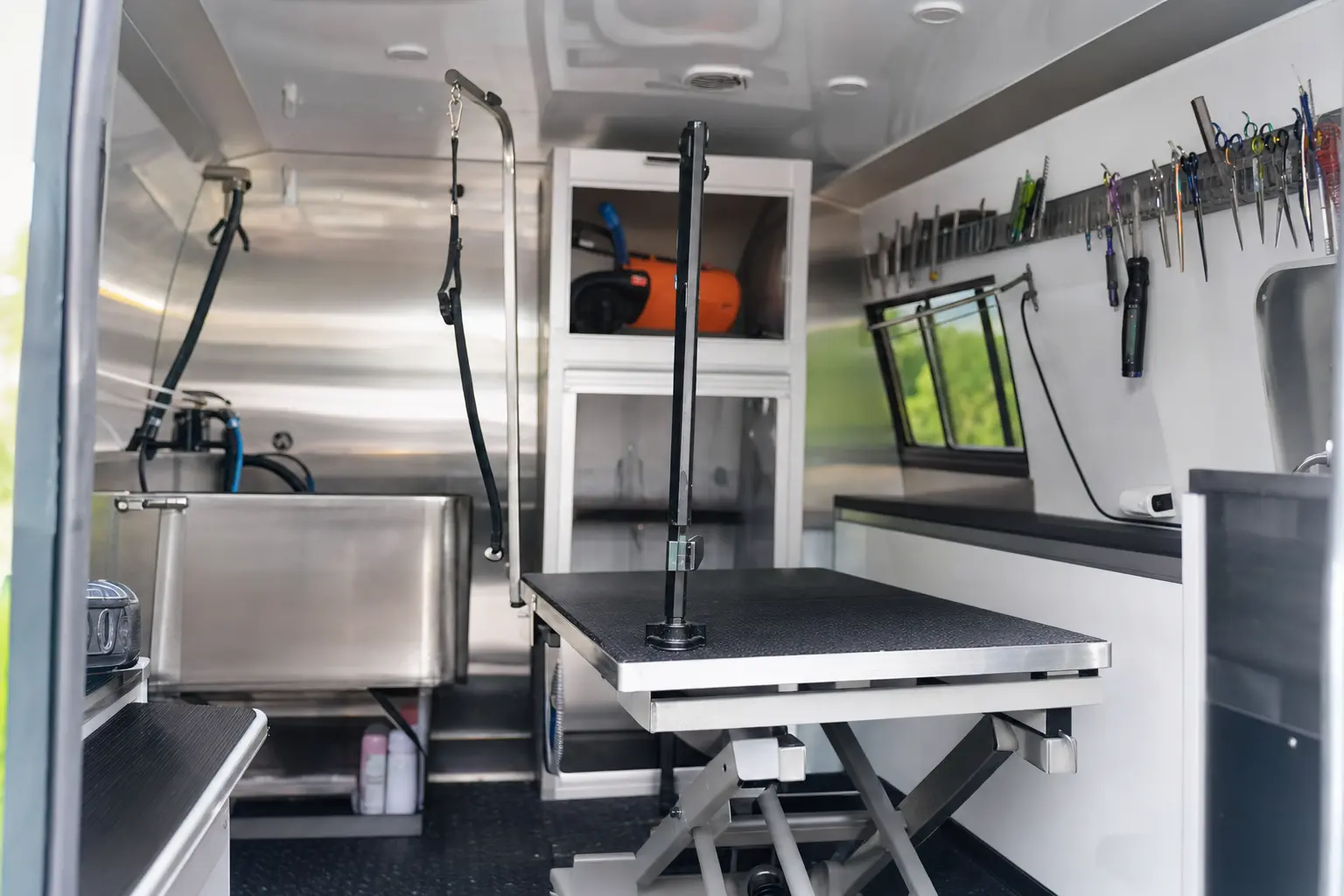
Safety is a non-negotiable core value in a mobile environment. A responsible operation uses documented procedures for preparing the van, handling pets. Maintaining a clean workspace, and responding when a pet becomes distressed or a service cannot safely continue. Owners should also make time for equipment checks and maintenance rather than treating van readiness as an afterthought.
Before the day begins, the team should confirm that the van, tools, water, sanitation supplies, and client information are ready for the scheduled route. After each appointment, the workspace should be reset according to the brand’s procedures. A safety-first culture is created through training, supervision, documentation, and a willingness to stop or escalate a situation when continuing would be unsafe.
Communicating with clients
Client communication is also an operational discipline. Clear appointment details, arrival updates, service notes, and follow-up conversations help set expectations before a groom begins and preserve trust afterward. Owners should monitor patterns in feedback and use them to improve training, scheduling, and service standards.
This is the practical heart of a franchise model: trained specialists deliver the service, and the owner builds the systems, culture, and accountability that make quality repeatable. Prospective owners can review Kontota’s training and support resources to understand how those responsibilities are developed.
How Scheduling Technology Keeps a Mobile Operation Moving
Scheduling technology helps a mobile franchise coordinate appointments, travel time, vehicle availability, customer records, reminders, and performance reporting. It does not replace management judgment. Owners still need to review route density, staffing capacity, service quality, and customer feedback before changing the schedule.
A mobile grooming business has a different scheduling challenge than a fixed-location salon. Each appointment includes service time, travel time, vehicle availability, and the needs of the local territory. A practical operating system helps the owner see those pieces together, so the day is managed as a coordinated route rather than a loose collection of bookings.
The first layer is booking. Incoming inquiries and repeat clients need to move into a dependable appointment process, with the relevant pet, address, service, and timing information captured accurately. That customer record gives the team context before arrival and reduces the risk of avoidable communication gaps.
Turning appointments into efficient routes
Route density is the relationship between the number of appointments served and the distance or time required to travel between them. When appointments are grouped sensibly within a protected territory, a van can spend more of its operating day serving clients and less time crossing unnecessary miles. The owner can use route information to identify scheduling patterns, evaluate territory coverage, and decide when additional capacity may be justified.
Technology also helps coordinate the customer-facing details around a route. Appointment reminders can reduce missed connections, while clear updates help clients understand timing when a mobile team is traveling between homes. Payment processing and service records create a more complete view of each customer relationship. The exact tools and features available depend on the franchise system and current materials, so prospective owners should verify those details during due diligence.
Using data to manage the business
Useful operating metrics may include appointment volume, travel time, schedule utilization, repeat booking behavior, customer communication, and vehicle availability. Reviewing these measures helps an owner ask better questions: Is the schedule balanced? Are certain areas creating excessive drive time? Does staffing match demand? Are follow-up processes consistent? The goal is visibility followed by a measured management decision.
Technology is useful only when someone acts on what it reveals. Owners should establish a regular review rhythm, document decisions, and compare the results with the standards in the franchise system. Ask which reports are included, who owns the data, what training is provided, and how software costs or requirements may change over time.
For a wider look at how the vehicle, territory, and customer experience fit together, review the mobile dog grooming business model.
What Does It Cost to Run a Pet Grooming Franchise?
The cost of running a pet grooming franchise includes more than an initial investment. Candidates should assess vehicle and equipment needs, staffing, insurance, supplies, technology, marketing, working capital, and recurring fees. The current FDD and franchise agreement are the controlling sources for exact figures and obligations.
Evaluating the cost of a pet grooming franchise means looking beyond the initial check. The operating budget must support the vehicle, trained team, customer experience, technology, compliance, and working capital required to build a dependable local business. Kontota’s mobile model is designed for entrepreneurs who want a home-based, low-overhead operation, but lower overhead does not mean zero overhead or zero management responsibility.
Exact fees, required investment, royalties, technology charges, qualification standards, discounts, and other financial terms must be taken from the current Franchise Disclosure Document and the applicable franchise agreement. Earlier web pages, third-party comparisons, or informal planning figures may be outdated or incomplete. Candidates should review the current FDD in full and use the franchisor’s written disclosures as the controlling source.
| Area to review | Questions to ask | Authoritative source |
|---|---|---|
| Initial investment | What does the current estimate include, exclude, and assume about working capital? | Current FDD and franchise agreement |
| Recurring fees | How are royalties, technology charges, marketing contributions, and other fees defined? | Current FDD and written fee schedule |
| Territory | How are boundaries, availability, population, and expansion rights determined? | Current FDD and territory documents |
| Owner readiness | What financial resources, management capacity, and staffing plan are expected? | Qualification discussion and personal budget |
Budget for the costs between launch and steady operations
Working capital gives the business room to operate while the owner hires, trains, markets, and develops recurring customer relationships. The right amount depends on the launch plan, staffing approach, territory, and pace of bookings. It should be evaluated against the current FDD and a personal operating budget rather than a generic benchmark.
Ongoing planning should also account for groomer wages and related staffing costs, vehicle upkeep, insurance, marketing, software, supplies, and territory-specific expenses. A mobile operation avoids some fixed costs associated with a storefront, but vans still require maintenance and readiness checks. Marketing remains an operating responsibility, even when brand materials or systems are available.
The key diligence question is not simply whether the headline investment fits. It is whether the candidate understands each cost category, has adequate financial capacity, and is prepared to manage the business system responsibly. Never treat a cost estimate as a projection of revenue, profit, or return.
How Territories, Marketing, and Customer Retention Work Together
Territory planning, local marketing, and customer retention are connected operating functions. A practical territory supports efficient routes, marketing fills the schedule, and reliable service encourages repeat appointments. Owners should evaluate the three together rather than assume that population size alone predicts business performance.
A mobile grooming operation grows through coordinated local decisions. Territory selection determines where a van can serve customers efficiently, marketing creates awareness in that area, and the customer experience determines whether appointments become an ongoing relationship. For an investor, the important question is not simply how many households are in a market. It is whether the territory, service radius, staffing plan, and operating systems can work together.
Start with territory potential, not just population
A protected territory can give a franchise owner a defined market in which to build local recognition and a customer base. That protection does not replace analysis. Candidates should evaluate household density, drive times, road patterns, pet ownership indicators, competitive conditions, and the practical distance between scheduled appointments. Kontota’s franchise FAQs offer additional context, while the current FDD and territory documents control the specific opportunity.
A territory that looks attractive on a map may require too much travel if demand is scattered. A focused service area can make routing and customer communication more manageable. Ask Kontota how territory boundaries, population, market conditions, and availability are evaluated, because the current FDD and direct conversations with the franchisor remain the sources for official terms.
Turn local awareness into recurring appointments
Marketing has a practical role beyond generating an initial inquiry. Local search visibility, referral activity, neighborhood awareness, and timely follow-up help fill the schedule with customers who are a reasonable fit for the service area. Once a customer books, the operation must make the next appointment easy to schedule.
Recurring appointments can make demand more predictable, but they are not automatic and should never be treated as a guaranteed financial outcome. Retention depends on delivering the promised experience, responding professionally when plans change, and maintaining safety as a non-negotiable operating standard. Owners should monitor rebooking behavior, cancellations, customer feedback, route efficiency, and lead sources.
Scale capacity when the operation is ready
Adding another van is an operational decision, not a milestone to pursue on a preset timetable. An owner should first assess sustained demand, available groomer talent, management bandwidth, service quality. Vehicle upkeep, and whether the existing territory can support additional capacity without weakening route efficiency.
The model can support full-time owner-operators and a semi-absentee pathway with an Operations Manager, but either approach requires clear accountability and dependable systems. The strongest expansion decision is the one supported by operating data and customer experience, not by an assumption that more vehicles alone will produce better results.
What Does a Well-Run Operating Day Look Like?
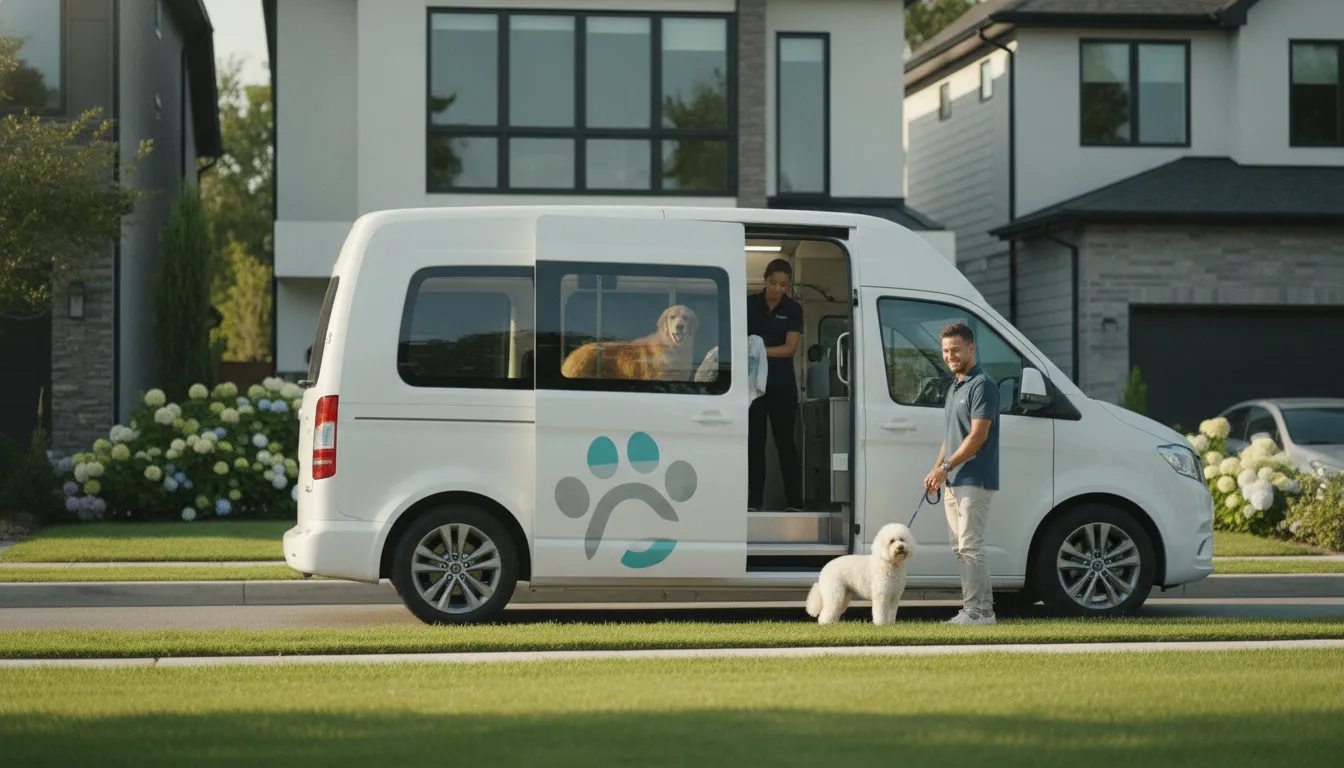
A well-run mobile grooming day follows a repeatable rhythm: prepare the vehicle and team, deliver scheduled services safely, communicate throughout the route, reset the workspace, and review performance. This rhythm gives owners practical checkpoints for managing quality without needing to perform every grooming task themselves.
Prepare before the first appointment
Preparation starts with reviewing the route, confirming appointment details, checking the vehicle, and making sure the groomer has the supplies and client information needed for the day. A short team check can surface schedule changes, pet-specific concerns, staffing gaps, or equipment issues before they affect a customer. Owners should define who handles each decision and how urgent issues are escalated.
Protect service quality during the route
During service hours, the owner or Operations Manager should monitor whether appointments are running on time and whether the team has what it needs. That does not mean interrupting every groom. It means creating a clear channel for questions, reviewing exceptions, and responding when a pet, customer, vehicle, or route creates an unexpected problem. Consistent notes make the next appointment easier to prepare for.
Close the loop after service
At the end of the route, the team should clean and reset the van, record service information, confirm follow-up needs, and review the next day’s schedule. Owners can use this review to spot recurring delays, supply usage, customer concerns, and training opportunities. A simple operating cadence turns individual observations into decisions that can improve reliability as the business grows.
What Support Should Franchise Owners Expect Before Launch?
Before launch, a prospective owner should expect clear information about training, territory development, van readiness, staffing, marketing, technology, and daily responsibilities. Kontota describes a roughly 90-day launch path, but candidates should confirm the timeline and each support commitment in current written materials.
Strong pet grooming franchise business operations begin before the first appointment. The pre-launch period should give you a practical view of the business, the territory, the staffing plan, and the support available to execute it. It is also your opportunity to test whether the model fits your goals, resources, and preferred level of involvement.
Kontota describes a launch path of roughly 90 days from inquiry to opening, but timing can vary with territory decisions, financing, hiring, training, vehicle readiness, and other conditions. Treat that figure as planning context, not a guarantee.
Use the pre-launch period to test the operating plan, not just the brand story. Ask who is responsible for recruiting and supervising groomers, which training is delivered to the owner and team. How van acquisition and setup are handled, and what marketing support is actually included. Confirm how scheduling technology, customer records, service standards, and escalation procedures fit together. A useful conversation should also clarify the owner-operator and Operations Manager pathways, the expected cadence of coaching, and the decisions that remain with the local franchise owner. These questions help an investor compare the written support commitment with the practical work required to open and manage the business. They also make the discovery call more productive because the candidate arrives prepared to discuss territory, capital planning, staffing, and personal involvement. No support program eliminates the owner’s responsibility to follow the agreement, protect the customer experience, and develop the local operation.
A disciplined evaluation process can look like this:
- Start with a discovery call. Explain your goals and ask direct questions about ownership responsibilities. You do not need grooming experience, but you should understand that the owner leads the business, develops the team, monitors customer experience, and makes operating decisions.
- Review the territory. Examine the proposed protected territory, local demand, travel patterns, staffing realities, and the practical distance a mobile unit can serve. Ask what assumptions inform the territory recommendation.
- Read the current FDD. Review fees, obligations, restrictions, renewal terms, litigation and bankruptcy disclosures, financial performance representations if provided, and other required information. Take the document to an independent franchise attorney and accountant.
- Validate the system. Ask to speak with current franchise owners, understand training and support, and visit headquarters or complete the process the franchisor describes. Compare what you hear with the written documents.
- Sign only after required review. Move forward only after you understand the agreement, applicable waiting period, finances, territory, and responsibilities. There should be no pressure or obligation to proceed before you are ready.
Review Kontota’s franchise support information and investment resources as part of that process. The purpose of a discovery call is mutual fit and informed evaluation, not a promise of earnings.
Request the full franchise information and book a no-pressure discovery call.
Frequently Asked Questions
Do I need grooming experience to run a pet grooming franchise?
No. Kontota states that grooming experience is not required. Franchise owners can hire trained groomers and focus on leadership, staffing, customer experience, local business development, financial oversight, and operating standards. The owner remains responsible for developing the business and supporting the team.
What are the essential operations in a pet grooming franchise?
Core operations include hiring, training, scheduling, routing, vehicle readiness, equipment maintenance, sanitation, safety, customer communication, marketing, financial management, and performance review. A franchise system may provide procedures and support, but the owner must manage execution in the local territory.
How do mobile grooming franchises manage scheduling?
They coordinate appointment details with service duration, travel time, vehicle availability, and territory geography. Scheduling tools can help with reminders, customer records, route planning, and reporting. Candidates should verify which tools are included and how technology requirements are handled in the current franchise documents.
What support can franchise owners expect for daily operations?
Support may include initial business and groomer training, operating procedures, guidance on staffing and customer service, marketing resources, technology systems, and continued coaching. Review the current FDD, franchise agreement, and support materials to distinguish documented obligations from informal expectations.
What is the typical launch timeline for a pet grooming franchise?
Kontota describes a launch path of roughly 90 days from inquiry to opening. Actual timing can vary based on territory analysis, financing, hiring, training, vehicle preparation, and other conditions. Treat the timeline as a planning estimate, not a guarantee.