
When investors compare a dog grooming franchise vs pet franchise investment, the right question is not which category sounds most appealing. It is which operating model matches your capital plan, staffing goals, desired owner role, market, and tolerance for complexity. Dog grooming, boarding, daycare, retail, and other pet franchises serve the same broad industry. They create very different daily businesses.
Book a call with Kontota to discuss your franchise goals.
This guide gives prospective franchise owners a practical comparison. It focuses on business structure and due diligence, not earnings promises. For a detailed investment framework, review Kontota’s dog grooming franchise cost guide. Then review the current Franchise Disclosure Document before making a decision.
The Pet Franchise Category: What Types of Businesses Are Available?
Pet franchises include service businesses that care for animals, businesses that sell products, and concepts that combine several services. The key differences are where the service happens, how customers return, how many employees are required, and whether the owner manages a facility, a route, or a retail operation.
- Dog grooming franchises: Provide grooming through a salon, mobile van, or a mix of locations.
- Pet boarding franchises: Care for pets during overnight stays or longer periods, usually in a dedicated facility.
- Dog daycare franchises: Supervise groups of pets during the day and may add boarding or grooming.
- Pet retail franchises: Sell food, supplies, accessories, and sometimes services through a storefront or online channel.
- Multi-service pet franchises: Combine services such as grooming, daycare, boarding, training, or retail under one operating model.
Each category can have demand, but demand alone does not make an opportunity suitable. A buyer should compare capital needs, property or vehicle requirements, labor, service capacity, local rules, and franchisor support. The best comparison starts with the work required to operate the business, not with the category label.
It also helps to separate the consumer promise from the owner responsibility. A pet owner may value convenience, availability, or a broad selection of products. The franchise owner must build the systems that deliver that promise. Those systems may include recruiting, scheduling, inventory controls, facility management, safety procedures, local marketing, and customer retention.
How Should You Compare a Dog Grooming Franchise With Other Pet Investments?
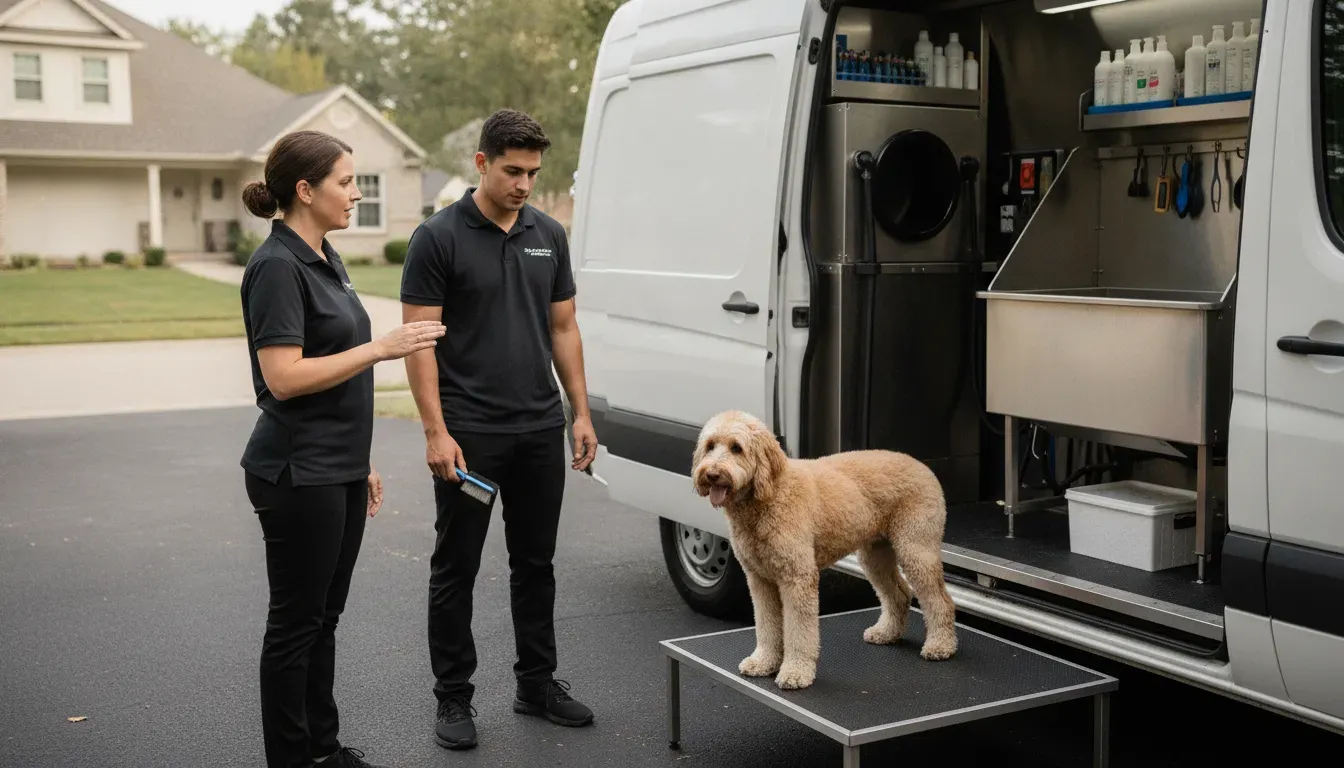
A dog grooming franchise investment gives an owner a service business built around scheduled appointments, trained service professionals, and repeat customer relationships. A mobile model can operate from a home base and deliver grooming at the customer’s property. That changes the cost structure and owner responsibilities compared with a pet facility or retail store.
Kontota positions its opportunity for entrepreneurs, investors, career-transition professionals, and existing business owners. Professional grooming experience is not required. The owner can focus on hiring, leadership, customer relationships, marketing, scheduling, finances, and business development while trained groomers deliver the service.
That distinction matters in a comparison. An investor who wants to perform every grooming appointment may evaluate the opportunity differently from an owner who wants to build a team. Neither path is automatically better. The question is whether the franchise system provides training and operating support that match the owner’s intended role.
What can make the mobile model different?
- No traditional salon lease: A home-based operation may avoid the fixed cost and buildout requirements of a customer-facing storefront. The business still needs an equipped van, insurance, supplies, permits, and working capital.
- Route-based capacity: The business serves customers in a defined territory. Route density and drive time affect productivity.
- Recurring appointments: Grooming customers often schedule follow-up care. That can create repeat demand when the service and customer experience support rebooking.
- Team-based growth: A franchisee can add trained groomers and vans as capacity and territory conditions support expansion.
- Customer convenience: A mobile appointment comes to the customer’s home. It can provide one-on-one attention without a salon waiting area.
Kontota emphasizes mobile grooming vans, safety-first operations, technology-supported scheduling, and a possible Operations Manager pathway as the business develops. These are operating features to investigate. They are not guarantees of profitability or semi-absentee ownership.
Get Started by reviewing your market and owner-operator goals with Kontota.
How Does Grooming Compare With Boarding, Daycare, and Retail?
Dog grooming, pet boarding, daycare, and retail can all serve pet owners. Their economics are shaped by different constraints. Grooming is appointment and route driven. Boarding and daycare are space and staffing driven. Retail is inventory and location driven.
- Mobile dog grooming: Vans, routes, and groomer availability shape capacity. Customers typically book repeat appointments. Owners focus on staffing, scheduling, service quality, and territory growth.
- Salon grooming: Facility capacity, lease terms, and groomer availability shape capacity. Customers typically book local appointments. Owners focus on the facility, staff, and customer experience.
- Pet boarding: Facility space, occupancy, and care coverage shape capacity. Customers book overnight or extended stays. Owners focus on property, staffing, safety, and utilization.
- Dog daycare: Facility space, supervision, and attendance shape capacity. Customers use daytime visits or packages. Owners focus on safety, staffing, enrollment, and utilization.
- Pet retail: Inventory, location, and competition shape performance. Customers make purchases and replenishment visits. Owners focus on purchasing, sales, margins, and inventory control.
| Model | Main owner focus |
|---|---|
| Mobile grooming | Routes, vans, staffing |
| Salon grooming | Facility, staff, experience |
| Boarding | Property, coverage, safety |
| Daycare | Supervision, enrollment, safety |
| Retail | Inventory, sales, location |
The table is a framework, not a ranking. A facility model may suit an investor with commercial real estate experience and a strong local demand case. A mobile dog grooming franchise may fit someone who prefers a lower-footprint service model and is prepared to recruit and manage groomers. Retail may fit an operator who understands inventory and customer acquisition better than route operations.
Investors should separate the consumer experience from the owner’s job. A customer may love the convenience of mobile grooming. The franchise owner must manage vehicle maintenance, route planning, recruiting, service standards, customer retention, and local marketing. The investment decision should be based on the complete operating role.
Where do the models differ most?
Facility businesses concentrate risk in a physical site. They must manage leases, buildout, utilities, maintenance, cleaning, and daily coverage. Mobile businesses concentrate risk in vehicles, routes, weather, maintenance, and staff availability. Retail businesses concentrate risk in inventory, merchandising, purchasing, and location performance.
None of these differences makes one category universally superior. They show why investors should compare the business they will operate, rather than comparing broad industry demand alone.
What Are the Overhead and Staffing Differences?
The biggest difference between pet franchise categories is often not the service price. It is the way the business uses space, labor, equipment, and time. Mobile grooming replaces some facility overhead with vehicle and route management. Boarding and daycare replace vehicle logistics with property costs and broader daily staffing coverage. Retail adds inventory and storefront responsibilities.
Mobile grooming staffing
A mobile grooming owner needs reliable groomers, a hiring process, clear training standards, scheduling discipline, and a way to maintain consistent service quality across vans. Kontota’s support model describes training in hiring and human resources, customer acquisition and scheduling, grooming processes, safety, quality control, and business systems.
Candidates should ask how those resources are delivered, what the owner must handle, and what staffing assumptions appear in the current FDD. They should also ask how the system supports recruiting when local labor is tight. A training program is useful, but the franchise owner remains responsible for building and leading the local team.
Facility-based staffing
Boarding and daycare may require coverage across opening hours, weekends, holidays, cleaning, animal supervision, intake, and emergency procedures. Staffing can be more continuous because pets remain at the facility. A buyer should examine occupancy assumptions, local licensing, property requirements, care standards, and the management experience needed to run the site safely.
Retail staffing and inventory
Retail operations require purchasing, receiving, merchandising, shrink control, inventory turns, and customer service. The owner may have more control over a fixed location but also takes on lease, utilities, and inventory exposure. A retail concept can suit an experienced store operator. A buyer should not assume that a large product selection automatically creates recurring revenue.
For any category, ask the franchisor to explain labor assumptions in plain language. How many people are needed at launch? Which positions are difficult to fill? What training is required? What happens if a key employee leaves? These questions often reveal more practical risk than a headline investment range.
How Do You Evaluate Investment Structure Without Comparing Unsupported Prices?
A responsible franchise comparison looks beyond the initial fee. It maps every required and likely expense to the operating model. For a mobile grooming concept, that may include the franchise fee, vehicle and equipment, insurance, permits, technology, recruiting, training, marketing, and working capital. For a facility concept, the list may also include real estate, construction, utilities, cleaning, and occupancy costs. Retail adds inventory and merchandising needs.
Kontota’s current approved franchise materials list a $42,000 initial franchise fee and an estimated total initial investment of $95,000 to $153,500. They also state a 7% royalty, a $100 monthly technology fee, and a minimum recommended net worth of $250,000. A qualified veteran discount and financing options may be available to eligible candidates. Ask for the current FDD to confirm every amount, assumption, and eligibility condition before relying on any figure.
These figures are specific to the current materials and should not be treated as a promise of financial performance. Confirm the amounts, assumptions, territory terms, and required expenses in the current FDD. Review the applicable Item 19 disclosure for any financial performance representation. If a figure is not disclosed there, do not assume it applies to your market or future results.
For a broader review of the cost categories, see Kontota’s franchise cost and investment guide. That page serves a different search purpose. This article focuses on choosing among pet franchise models. For the separate decision between a franchise system and an independent startup, see mobile pet grooming franchise or independent business.
Investors should also ask what the recurring fees fund. Review technology, support, marketing, training, territory rights, renewal terms, transfer terms, and required suppliers. The goal is not to find the lowest headline cost. The goal is to understand the full obligation and decide whether the support and operating model justify further diligence.
Which Pet Franchise Is Best for a Career-Transition Investor?
The best pet franchise for a career-transition investor depends on preferred work, capital plan, skills, and willingness to build a team. A dog grooming franchise may fit someone who values a service business, recurring appointments, a home-based structure, and a path to multi-van growth. It still requires active leadership, especially during launch.
- Define your desired owner role: Decide whether you expect to groom, manage one van, build a team, or eventually hire an Operations Manager. Treat a semi-absentee path as a possible later stage, not a day-one assumption.
- Match the model to your strengths: Route planning and recruiting matter in mobile grooming. Facility operations matter in daycare and boarding. Inventory, sales, and merchandising matter in retail.
- Build a complete capital plan: Include fees, equipment or property, insurance, permits, technology, staffing, marketing, personal expenses, and working capital. Reconcile the plan with the current FDD.
- Test local demand: Review population, household density, pet ownership, competition, service radius, traffic, and the ability to build efficient routes or fill a facility.
- Read the FDD carefully: The Federal Trade Commission Franchise Rule requires a franchisor to provide a disclosure document with 23 specific items. Review fees, obligations, litigation and bankruptcy disclosures, franchisor financials, franchisee contacts, renewal terms, and any Item 19 financial performance representation.
- Speak with current franchise owners: Ask about training, support responsiveness, hiring, marketing, route density, owner workload, and costs that were difficult to anticipate. Compare what you hear with the FDD and the written franchise agreement.
Also review the franchisor’s operational philosophy. Kontota emphasizes safety-first operations, technology-supported systems, owner training, groomer training, and continued franchise-partner support. Use those claims as diligence questions. Ask to see how training is delivered and how owners receive help as they add vans or territories.
The American Pet Products Association reported $158 billion in U.S. pet industry spending for 2025 in its March 26, 2026 update. A large industry can support many business models. Market size is not a substitute for local execution, clear staffing assumptions, or FDD review.
Book a call to review the Kontota model, territory questions, and your intended owner role.
What Questions Should You Ask Before Choosing a Pet Franchise?
Use the discovery process to test whether the opportunity fits your goals. A useful conversation should cover more than brand enthusiasm. Ask questions that connect the franchise promise to your responsibilities as an owner.
- What does the owner manage during the first 90 days?
- Which tasks require the owner to be present every day?
- What recruiting support is available for groomers or facility staff?
- How are territories defined, protected, and evaluated?
- What technology systems support scheduling, routing, customer records, and reporting?
- Which expenses are required before opening, and which are optional?
- What does the current FDD say about fees, renewal, termination, and transfer?
- What do current franchisees say about training, support, staffing, and owner workload?
- What conditions must exist before an Operations Manager can take on day-to-day duties?
Kontota’s franchise FAQ resource can help candidates understand common questions. It should be used with the current FDD, franchise agreement, professional legal advice, and direct franchisee validation. No article can replace that review.
Book now to review the Kontota franchise opportunity with the development team.
Frequently Asked Questions About Dog Grooming Franchise Investment
Is a dog grooming franchise a pet franchise?
Yes. A dog grooming franchise is one type of pet franchise, alongside boarding, daycare, retail, training, and multi-service concepts. The key distinction is the operating model. Grooming is usually appointment based, while boarding and daycare depend more heavily on facility capacity and daily supervision.
Do I need grooming experience to invest in a dog grooming franchise?
Not necessarily. Kontota states that franchise owners do not need professional grooming experience because they can hire trained grooming professionals. Owners still need leadership, financial management, hiring, customer service, and business development skills. They should understand the training and staffing obligations in the current FDD.
Is mobile grooming lower overhead than a pet facility?
Mobile grooming can avoid a traditional customer-facing salon lease, but it is not overhead free. The owner must budget for an equipped van, insurance, maintenance, supplies, fuel, technology, staffing, marketing, permits, and working capital. Compare the full cost structure rather than one expense category.
Can a dog grooming franchise become semi-absentee?
A mobile dog grooming franchise may offer a pathway to an Operations Manager as the business grows. Semi-absentee ownership depends on trained staff, reliable systems, financial controls, and sufficient operating scale. Prospective owners should ask when delegation is realistic and what responsibilities remain with the franchisee.
What should I compare before choosing a pet franchise?
Compare the total initial investment, recurring fees, territory, staffing model, facility or vehicle requirements, training, support, customer retention pattern, owner workload, financing assumptions, and FDD disclosures. Then speak with current franchisees. Evaluate whether the model matches your skills and intended level of involvement.
Book now to review the Kontota franchise opportunity with the development team.
There is no universal winner in a dog grooming franchise vs pet franchise investment comparison. The strongest decision is supported by a complete capital plan, a realistic owner role, local demand research, current FDD review, and direct conversations with franchisees. If the mobile dog grooming model fits those criteria, Kontota can help you evaluate the opportunity and next steps without making the decision for you.

