
If you are researching pet grooming franchise ROI, the most useful answer is not a headline percentage. It is a repeatable model that shows how startup capital, appointment volume, labor, route density, recurring customers, and owner involvement work together. This guide explains how to build that model without treating an illustration as a promise of future results.
Book a no-pressure franchise consultation
A mobile dog grooming franchise can be attractive to an investor who wants a service business with repeat demand and a home-based operating structure. It is also a labor-intensive, vehicle-dependent business. A sound ROI review has to account for both sides of that equation: the opportunity to build a dense route and the cost of staffing, maintaining, and managing the operation.
What Does ROI Mean for a Service Franchise Owner?
For a service franchise owner, ROI is the relationship between the capital invested and the cash the business produces after operating expenses. A complete model separates gross sales, operating cash flow, owner compensation, debt service, taxes, and resale value. ROI is a planning tool, not a guarantee, and it is only as reliable as its assumptions.
Use three related measures rather than one:
- Operating cash flow: revenue minus the costs required to deliver services and run the business.
- Cash-on-cash ROI: annual cash available to the owner divided by the owner’s cash invested.
- Payback period: the time required for cumulative cash available to recover the initial investment.
A simple annual formula is:
Cash-on-cash ROI = annual cash available to owner / total cash invested x 100
That formula needs a precise definition of “cash available.” If a franchisee must hire a groomer, pay a manager, or make loan payments, those items belong in the model before calculating a return. If the owner performs grooming personally, the model should still assign a market wage to that work. Otherwise, the apparent ROI may simply be unpaid labor.
Break-even is different from ROI. Break-even asks when revenue covers operating costs. ROI asks whether the total capital invested is producing an acceptable return after the business reaches a sustainable operating level. The U.S. Small Business Administration’s break-even guidance is a useful starting point for organizing fixed and variable costs, but a franchise buyer should adapt the exercise to the actual FDD and territory plan.
Which Variables Drive Mobile Grooming Franchise ROI?
Mobile grooming ROI is driven by productive service capacity, not van ownership alone. The most important variables are appointments completed, average ticket, route efficiency, rebooking, groomer labor, vehicle uptime, customer acquisition, recurring fees, working capital, and the amount of management time the owner must supply.
1. Appointment capacity and utilization
Start with a capacity equation:
Monthly service revenue = completed appointments x average ticket
Do not use theoretical capacity as the base case. Model appointments that can actually be completed after travel, cleaning, breaks, cancellations, weather, maintenance, and schedule gaps. A route with fewer miles between appointments may produce more cash than a larger territory with scattered demand.
2. Route density and territory quality
A protected territory does not automatically create a profitable route. Before investing, examine household density, dog ownership, income levels, competition, parking logistics, travel times, and local demand for recurring grooming. Ask how the franchisor defines territory protection, what boundaries are included, and whether the available ZIP codes are still open.
3. Average ticket and recurring customers
Average ticket is useful only when paired with retention. A high first appointment price does not produce a dependable model if customers do not rebook. Track the assumptions separately:
- New customers per month
- Average completed appointments per customer
- Rebooking rate
- Average revenue per appointment
- Cancellation and no-show rate
- Revenue mix by service and dog size
4. Labor and the owner role
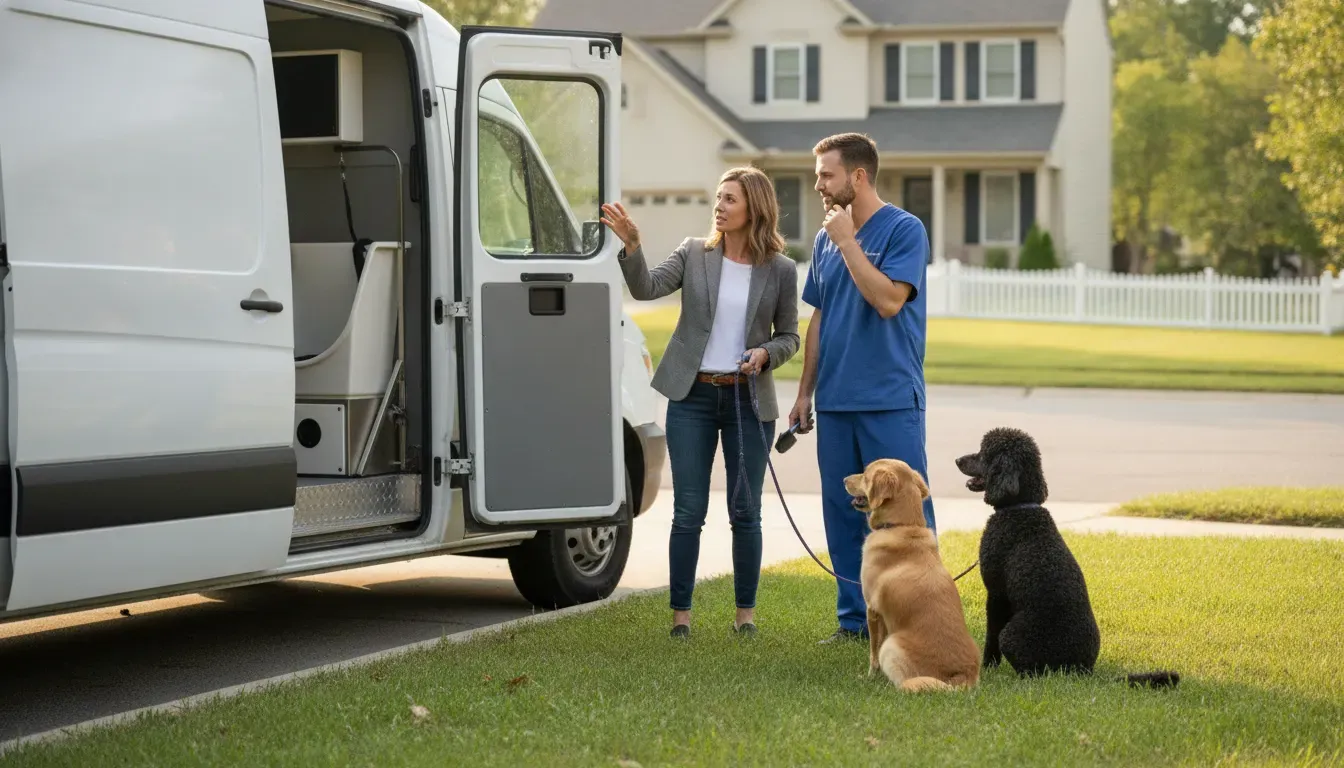
Kontota positions the opportunity for candidates who do not have to be professional groomers. The owner can focus on hiring, customer service, scheduling, marketing, safety, financial management, and business development while trained groomers deliver services. That broadens the candidate pool, but it also means payroll and recruiting must be modeled honestly. An eventual Operations Manager pathway is not the same as day-one absentee ownership.
5. Fees, vehicle costs, and working capital
Use the current FDD as the controlling source for franchise fees and required investment. Kontota’s current franchise information identifies a $42,000 initial franchise fee and an estimated total initial investment of $95,000 to $153,500. The current materials also identify a 7% royalty, a $100 monthly technology fee, and a minimum recommended net worth of $250,000. These figures can change, so confirm the current FDD before making a decision.
For the complete startup-cost breakdown, review Kontota’s dog grooming franchise cost guide and its mobile pet grooming franchise investment guide. In this article, the focus is what to do with those inputs after they are verified, not to replace the cost guide.
What Does a Conservative vs. Optimistic ROI Model Look Like?
A useful ROI model shows a range of outcomes instead of one forecast. The example below is hypothetical and is provided only to demonstrate the math. It is not a representation of Kontota franchisee performance, an earnings claim, or a prediction. Replace every assumption with information from the current FDD, local research, lender terms, and your operating plan.
| Illustrative assumption | Conservative case | Optimistic case |
|---|---|---|
| Monthly gross revenue | $8,000 | $16,000 |
| Annual gross revenue | $96,000 | $192,000 |
| Groomer labor | $42,000 | $72,000 |
| Vehicle and operating costs | $22,000 | $30,000 |
| Royalty at 7% of gross | $6,720 | $13,440 |
| Technology fee at $100 per month | $1,200 | $1,200 |
| Marketing and administration | $10,000 | $18,000 |
| Illustrative operating cash before tax and debt service | $14,080 | $57,360 |
| Illustrative cash invested | $120,000 | $120,000 |
| Illustrative cash-on-cash ROI | 11.7% | 47.8% |
| Simple payback period | 8.5 years | 2.1 years |
The calculation is intentionally transparent. In the conservative case, $96,000 of annual gross revenue is reduced by the listed operating assumptions, leaving $14,080 before tax and debt service. Dividing that amount by $120,000 of illustrative cash invested produces an 11.7% pre-tax, pre-debt-service return. The optimistic case uses stronger revenue and capacity assumptions, so its result is higher.
Neither scenario tells an investor what will happen. They show why a small change in utilization, labor, or route density can change the result. They also leave out taxes, financing costs, owner salary, major repairs, and resale value. Add each of those items before using a model for a personal investment decision.
Book a call to discuss your franchise ROI assumptions
How Should You Use the FDD Item 19 to Evaluate Earnings Claims?
Item 19 is the part of a Franchise Disclosure Document that may contain a franchisor’s financial performance representation. It can help an investor compare disclosed historical results with a model, but it does not make a forecast accurate. If Item 19 is absent, the investor should not fill the gap with a sales presentation, a competitor’s numbers, or an internet estimate.
The Federal Trade Commission’s Consumer’s Guide to Buying a Franchise, published in September 2020, explains why prospective franchisees should study the FDD and seek professional advice. The FTC’s Franchise Rule Compliance Guide also identifies Item 19 as the section for financial performance representations.
When reviewing Item 19, ask:
- Does the disclosure cover company-owned units, franchised units, or both?
- How many units are included, and how many are excluded?
- Is the figure gross revenue, gross profit, operating profit, or another measure?
- What period does the data cover, and are the units mature or recently opened?
- Are expenses, owner labor, debt service, taxes, and capital expenditures excluded?
- How closely does the disclosed group resemble the territory and operating plan being considered?
Do not convert gross revenue into owner income without a bridge of expenses. A credible bridge should include labor, vehicle costs, fuel or charging, supplies, insurance, maintenance, software, marketing, royalties, taxes, debt service, and a reasonable owner wage. Have a franchise attorney and accountant review the FDD and your assumptions before signing or paying.
How Do You Stress-Test the Model Before Investing?
Stress-testing asks whether the business can withstand a slower ramp, lower utilization, higher labor costs, or a major vehicle repair. An investor should test at least three cases, identify the assumptions that change the result most, and confirm that enough working capital remains after the initial investment and personal obligations are considered.
- Reduce appointment volume. Test what happens if the route reaches target capacity later than expected.
- Increase labor costs. Test higher wages, recruiting costs, turnover, training time, and a temporary vacancy.
- Lower rebooking. Model a slower buildup of recurring appointments instead of assuming every customer returns.
- Add downtime. Include maintenance, weather, illness, equipment failure, and unplanned schedule gaps.
- Separate owner pay. Include a market wage for owner work, or label clearly when the owner is not being compensated.
- Test financing. Add interest, principal payments, lender fees, and the effect of a larger cash requirement.
- Protect working capital. Keep personal living expenses and business reserves separate from the cash needed to buy the franchise.
Territory analysis deserves its own test. Compare the franchisor’s demand assumptions with local household data, competitor reviews, service pricing, drive times, and the number of groomers you can realistically recruit. Kontota’s franchise FAQs explain the discovery process, financing discussions, franchisee responsibilities, and the approximate 90-day launch timeline. Treat that timeline as a process description, not a guarantee that every territory will open or reach cash-flow targets on the same schedule.
How Does Mobile Grooming ROI Compare With Other Service Franchise Categories?
Mobile grooming ROI should be compared by operating structure, not by a single industry-wide percentage. A mobile model may avoid a traditional retail lease, but it adds vehicle, route, and staffing dependencies. Other service franchises may have different equipment, facility, labor, seasonality, and customer-acquisition profiles. Compare the assumptions that create cash flow rather than copying another category’s return claim.
| Comparison lens | Questions to ask |
|---|---|
| Fixed overhead | Does the model require a retail facility, a home office, vehicles, or specialized equipment? |
| Labor model | Who performs the service, how difficult are workers to recruit, and what happens during turnover? |
| Customer recurrence | How often do customers return, and what operational system encourages rebooking? |
| Service capacity | Is capacity limited by appointments, travel, room count, equipment, or territory size? |
| Owner role | Can the owner manage the business without performing the core service, and when? |
| Capital risk | What happens if the main vehicle, facility, or equipment is unavailable? |
Kontota’s mobile model is designed around a protected territory, technology-supported scheduling, a home-based structure, and the option to build toward an Operations Manager pathway. Its franchise support program describes training and ongoing guidance across hiring, scheduling, safety, quality control, customer acquisition, and business systems. Those systems may reduce operational friction, but they do not remove the owner’s responsibility to manage people, cash flow, and service quality.
What Should an Investor Do Before Making a Decision?
Before investing, turn the ROI model into a due-diligence checklist. Verify the current FDD, confirm territory availability, validate local demand, speak with current franchise owners, and identify the owner’s actual weekly responsibilities. A decision is stronger when the downside case remains fundable, not merely when the upside case looks attractive.
- Request the complete current FDD and read Items 5, 6, 7, 11, 12, 17, and 19 with professional advice.
- Confirm the current initial fee, total investment range, royalties, technology fee, working-capital assumptions, and any veteran incentive in writing.
- Ask how the territory is defined, protected, measured, and approved.
- Speak with current franchise owners about staffing, vehicle uptime, support responsiveness, customer acquisition, and route density.
- Build a monthly cash-flow model for at least the first 24 months.
- Decide whether your plan is owner-operated, manager-led, or intended to transition over time.
- Set a maximum cash commitment and a reserve that is not used to cover optimistic assumptions.
Kontota’s franchise process is designed as a mutual evaluation. A consultation can help a candidate request the current FDD, discuss a line-by-line Item 19 review if applicable, and ask about introductions to current franchise owners. There is no need to treat a first call as a commitment.
Book a call to review the current FDD and your ROI model
Frequently Asked Questions About Pet Grooming Franchise ROI
Pet grooming franchise ROI depends on the territory, utilization, labor plan, recurring customer base, operating costs, owner involvement, and capital structure. The most reliable approach is to replace generic assumptions with current FDD information, local market evidence, and a monthly cash-flow model that includes downside cases.
What is a good ROI for a pet grooming franchise?
There is no universal target that makes a franchise a good investment. Compare the expected return with the capital required, owner time, financing risk, opportunity cost, and downside case. Use disclosed financial performance only when it is provided in the applicable FDD, and do not treat an illustrative scenario as a benchmark.
How long does it take to recover a mobile grooming franchise investment?
Payback depends on revenue ramp, route density, labor costs, owner compensation, debt service, and working capital. Calculate it from cumulative cash available after operating expenses, not from gross revenue. A franchisor’s launch timeline describes opening steps and should not be presented as a guaranteed payback schedule.
Can someone without grooming experience achieve a franchise return?
A candidate may not need to groom professionally, but the owner still has to build and manage the business. That includes hiring trained groomers, overseeing safety and quality, managing schedules and finances, supporting customer relationships, and developing the territory. Confirm the training and support model before relying on hired labor.
Does a protected territory guarantee franchise ROI?
No. Territory protection can define the area in which the franchise operates, but it does not guarantee demand, pricing, staffing, retention, utilization, or profit. Evaluate local demographics, competition, route logistics, recruiting conditions, and the exact territory terms in the current FDD and franchise agreement.
Where can I find financial performance information?
Start with the current FDD. If the franchisor makes a financial performance representation, it should appear in Item 19. If the FDD does not include the information you need, ask the franchisor and your professional advisers how to evaluate the opportunity without relying on unsupported projections, testimonials, or competitor claims.

