
When investors compare a pet grooming franchise vs home services franchise, the best choice is not determined by which category sounds most familiar. It depends on how customers buy, how often they return, how much staffing and dispatch complexity the owner can manage, and what kind of day-to-day business the investor wants to build. For the broader buying process, review Kontota’s dog grooming franchise buyer journey.
Pet grooming is scheduled and relationship-based. Home services range from plumbing and HVAC to cleaning, restoration, landscaping, and handyman work. Some repeat, while others are triggered by a repair, project, weather event, or property need. That distinction matters more than the label.
This comparison is for franchise investors evaluating service categories. It separates the models by customer behavior, operations, and owner fit without treating any franchise as a guaranteed investment.
What Does the Home Services Franchise Category Include?
A home services franchise is a branded business that delivers maintenance, repair, improvement, or cleaning services at residential or commercial properties. It may include plumbing, heating and air conditioning, electrical work, pest control, restoration, lawn care, cleaning, painting, remodeling, or handyman services. Each trade has different licensing, staffing, equipment, and demand requirements.
For an investor, home services is a group of operating models rather than one business type. Cleaning may depend on repeat visits, HVAC may combine maintenance with urgent repairs, and restoration may spike after a property event. Comparing all of them to pet grooming without separating the operating model can mislead.
- Scheduled maintenance: Customers book service at planned intervals, creating opportunities for recurring relationships.
- Urgent repair: A breakdown or property problem creates immediate demand but can require rapid dispatch and extended hours.
- Project work: Larger jobs may produce higher individual invoices but often have longer sales cycles and more variable timing.
- Route-based service: Cleaning, lawn care, and some mobile services depend on geographic density and efficient scheduling.
Pet grooming fits the scheduled, route-based end of this spectrum. Its management challenge is filling routes, maintaining quality, staffing groomers, and encouraging rebooking.
How Does Demand Compare Between Pet Services and Home Repair or Cleaning?
Pet grooming demand is generally appointment-based and repeat-oriented, while home repair demand is more often triggered by a property condition, project, or breakdown. Cleaning and maintenance can resemble grooming because both can be scheduled. The useful comparison is therefore demand predictability and buying frequency, not a blanket claim that one category has more demand.
The broader pet market provides meaningful context. The American Pet Products Association reported 158 billion in U.S. pet industry spending in 2025 and approximately 95 million pet-owning households. Those figures describe the total pet industry, not mobile grooming revenue, but they show why investors continue to examine pet services as a large consumer category.
Pet grooming demand is built around repeat care
Grooming is a maintenance service. Many customers use recurring appointments, although timing varies by breed, coat, household preference, geography, and service type. A franchise owner can build a steadier route when customers rebook and appointments are grouped efficiently. Each route still has finite capacity, so growth requires planned staffing and equipment.
Customer trust is central because pet owners are choosing someone to handle an animal. Safety, communication, reviews, and continuity can influence retention. Kontota emphasizes a safety-first culture, trained groomers, and owner training that covers scheduling, hiring, quality control, and business systems.
Home services can mix recurring and event-driven demand
Home services can have strong demand because property systems require maintenance and problems cannot always be postponed. Timing may be less uniform. A plumbing call may be urgent, an HVAC visit seasonal, a cleaning visit weekly, and a remodeling project slower to begin. Evaluate the specific trade, lead sources, technician availability, service area, and response expectations.
The U.S. Bureau of Labor Statistics provides separate outlook information for trades such as plumbing and heating and air-conditioning work. That separation is a useful reminder for investors: home services is not one uniform market. A franchise should be evaluated at the trade and territory level.
Which Model Builds Client Acquisition and Retention Faster?
Neither model automatically acquires customers faster. Pet grooming often benefits from rebooking, referrals, local reviews, and a visible service route. Home services may benefit from search demand, memberships, referrals, property managers, and urgent-need calls. The faster path depends on local competition, the franchise system, lead economics, technician or groomer capacity, and the owner’s ability to deliver a reliable experience.
For a pet grooming franchise, retention is often tied to the next appointment. A groomer or customer-care team can ask for the next booking while the service experience is fresh. Route density can improve when appointments are concentrated geographically, reducing wasted travel time. That does not remove the need for marketing. A new territory still needs awareness, reviews, referrals, partnerships, and a consistent follow-up process.
Home services retention can come from maintenance plans, seasonal service, repeat property needs, or referrals. For urgent repairs, the first conversion may be quick, but future work depends on trust, workmanship, communication, and whether the customer has another need.
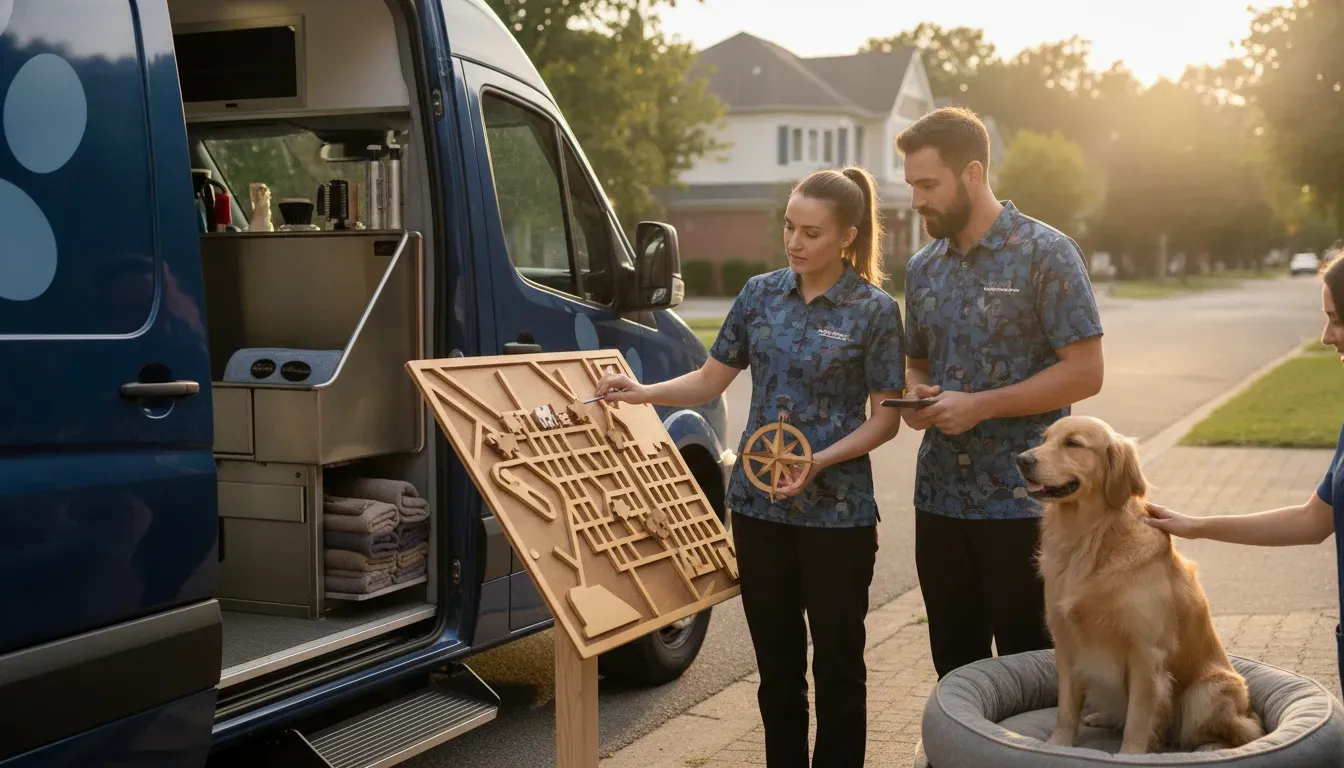
Investors should ask each franchisor how customers are acquired and retained, how leads are assigned, and which metrics owners track. In validation calls, ask about lead quality, rebooking, cancellations, staffing, seasonality, and the owner’s time commitment. Marketing language is not a substitute for operating evidence.
Are Pet Grooming Franchises More Seasonally Stable Than Home Services?
Pet grooming can offer a steadier appointment rhythm than a weather-dependent or emergency-oriented home service, but it is not season-proof. Grooming schedules can shift around holidays, travel, weather, household budgets, and staffing. Home services also vary widely: cleaning and maintenance may repeat, while landscaping, HVAC, restoration, and exterior work can be more exposed to weather and seasonal events.
Seasonality should be measured locally. A territory with extreme heat may create different HVAC patterns from a territory with cold winters, while coastal and inland markets may face different restoration risks. A dense suburban market may support route-based grooming more efficiently than a spread-out rural market. The question is how the owner plans for predictable cycles.
Pet grooming operators can prepare by building rebooking habits, monitoring route capacity, maintaining staffing depth, and planning promotions or partnerships around slower periods. A home services owner may use maintenance agreements, multiple service lines, commercial accounts, or seasonal staffing plans to smooth demand. Both models require working capital and a realistic view of the time between customer acquisition and collected revenue.
Do not treat a recurring appointment model as passive income. The owner still has to manage people, quality, customer communication, scheduling, safety, finances, and local growth. Kontota describes a potential path toward an Operations Manager as the business grows, but the timing and feasibility depend on the owner, territory, staffing, and FDD disclosures.
Which Category Offers Better Work-Life Alignment for Investors?
Work-life alignment depends on the owner’s preferred role. Pet grooming may suit someone who wants route operations and recurring local relationships. Home services may suit someone comfortable managing technicians, dispatch, vehicles, parts, licensing, urgent calls, or projects. Neither model removes the responsibility of building a real operating company.
How is demand often scheduled?
- Pet grooming franchise
- Planned appointments and repeat grooming cycles
- Home services franchise
- Scheduled maintenance, projects, or repair calls depending on the trade
What is the key capacity constraint?
- Pet grooming franchise
- Groomer availability, van capacity, route density, and appointment time
- Home services franchise
- Technician availability, dispatch coverage, equipment, parts, and service-area size
What can support retention?
- Pet grooming franchise
- Rebooking, consistent groomers, safety, communication, reviews, and referrals
- Home services franchise
- Work quality, response time, maintenance plans, repeat needs, and referrals
What may affect the owner schedule?
- Pet grooming franchise
- Staffing, route changes, customer care, vehicle issues, and quality control
- Home services franchise
- Dispatch, urgent calls, technician issues, project timing, weather, and compliance
Who may fit the model?
- Pet grooming franchise
- An investor who values recurring local relationships and route operations
- Home services franchise
- An investor who prefers trade-based operations, dispatch, projects, or maintenance accounts
Kontota states that no prior grooming experience is required because owners can employ trained groomers. That widens the candidate pool, but it does not eliminate the need for leadership, financial discipline, hiring, marketing, and customer-service skills. Compare the owner role described in the FDD with the role you actually want.
What Should Investors Compare Before Choosing a Service Franchise?
The strongest category decision comes from comparing operating requirements, not from choosing the most attractive headline. Examine the customer need, recurring revenue opportunity, labor model, territory density, capital requirements, owner schedule, franchisor support, and financial disclosures. Then validate those assumptions with franchisees in similar markets.
- Define the customer trigger: Is the service booked on a repeat schedule, purchased during a project, or requested after an urgent problem?
- Map the labor model: What skills, licenses, certifications, recruiting pipeline, training, and retention systems are required?
- Study territory economics: Consider population, household density, drive time, competition, service radius, and local customer acquisition costs.
- Separate revenue from owner workload: Ask what the owner does during launch, after staffing, and after adding a manager. Semi-absentee ownership should be treated as a possible operating stage, not a promise.
- Review the current FDD: Confirm fees, royalties, technology charges, territory terms, required purchases, restrictions, and any Item 19 financial performance representation.
- Validate with franchisees: Ask how long launch took, how staffing works, which costs surprised them, how leads are generated, and what they would want to know before signing.
For context, Kontota currently discloses a $42,000 initial franchise fee, an estimated total initial investment of $95,000 to $153,500, a 7% royalty on gross sales, and a $100 monthly technology fee. The current FDD controls the complete terms. Candidates should confirm net-worth requirements, territory availability, financing options, and applicable veteran or multi-territory provisions directly with Kontota.
The Federal Trade Commission guide to buying a franchise recommends careful review of the FDD and conversations with current and former franchisees. It is a useful general framework, not a substitute for professional legal, tax, or financial advice.
Frequently Asked Questions
Is a pet grooming franchise a home services franchise?
A pet grooming franchise is a service franchise that delivers care to customers, often at or near their homes, but it is not the same operating model as a plumbing, HVAC, cleaning, or restoration franchise. Pet grooming is typically appointment-based and relationship-driven, while other home services may center on repairs, projects, maintenance plans, or emergency response.
Which is more recurring, pet grooming or home services?
Pet grooming often has a naturally recurring appointment cycle, but the actual rebooking rate varies by customer, service, breed, territory, and execution. Home services can also recur through maintenance agreements, cleaning schedules, lawn care, or repeat property needs. Investors should ask for evidence from the specific franchise system and comparable territories instead of assuming one category is always more recurring.
Do I need grooming or trade experience to buy a franchise?
Requirements vary by franchisor and category. Kontota says candidates do not need prior professional grooming experience because owners can hire trained groomers and focus on managing the business. A home services franchise may have trade-specific licensing or qualified-person requirements. Review the FDD, franchise agreement, state rules, and the franchisor’s training and staffing expectations before making a decision.
Can a pet grooming franchise become semi-absentee?
Kontota describes an Operations Manager pathway that may become available as a business grows. This is an operating possibility, not a guaranteed result or a promise of passive income. The owner still needs adequate staffing, management systems, customer demand, cash reserves, and leadership oversight. Ask current franchisees how their roles changed as they added vans or delegated daily operations.
What should I review before choosing between these franchise categories?
Review the current FDD, total investment, fees, territory, staffing model, lead sources, customer retention, seasonality, owner workload, training, support, and Item 19 disclosure when one is provided. Then speak with current franchise owners and qualified advisers. A careful comparison should reveal whether the category fits your capital, skills, schedule, risk tolerance, and preferred operating role.
Sources and disclosures
- American Pet Products Association, 2025 U.S. pet industry spending and 2026 outlook.
- Federal Trade Commission, franchise disclosure document guidance.
- U.S. Bureau of Labor Statistics, plumbers and related trades.
- U.S. Bureau of Labor Statistics, heating and air-conditioning mechanics and installers.

