
Mobile Dog Grooming Business Plan: A Franchise Investor Template
A mobile dog grooming business plan helps a franchise investor turn a promising concept into a testable operating model. It should explain the territory, customers, staffing plan, van operations, startup assumptions, ongoing costs, risks, and decision points. This template is designed for entrepreneurs evaluating a franchise opportunity, not for presenting unsupported earnings projections.
Get Started with a Franchise Discovery Call
Why This Mobile Dog Grooming Business Plan Matters for Franchise Investors
A franchise gives you a brand, operating system, training, and support, but it does not remove the need for owner-level planning. Your business plan tests how the franchise model fits a specific market, your available capital, your management approach, and the day-to-day reality of building a mobile route.
The U.S. Small Business Administration describes a business plan as a roadmap for starting, managing, and growing a business. For a franchise investor, that roadmap should connect the franchisor’s system to your local execution plan. It should also make clear which facts come from the current Franchise Disclosure Document, which assumptions require validation, and which decisions belong to you.
A useful plan helps you:
- Define the owner role, including whether you will manage the first van directly or hire an Operations Manager.
- Evaluate whether the proposed territory can support route density and repeat appointments.
- Model startup capital, working capital, payroll, vehicle costs, royalties, and technology fees.
- Identify the people, training, systems, and safety procedures required before opening.
- Prepare focused questions for the FDD review, validation calls, and franchise agreement discussion.
Use the SBA business plan guidance as a general planning reference, then adapt the sections below to the mobile dog grooming franchise you are evaluating. The plan is a diligence tool. It is not a guarantee of sales, profit, financing approval, or investment return.
How to Start Your Mobile Dog Grooming Business Plan Executive Summary
The executive summary should state what you plan to build, who will operate it, where it will operate, and what you need to validate before signing. Write it last, after the market, financial, and operations sections are complete, so the summary reflects evidence rather than enthusiasm.
Keep the first draft to one page and answer these questions:
- What is the concept? Describe the mobile dog grooming franchise, its customer experience, and the service territory.
- Who is the owner? Explain your management experience, financial readiness, and time commitment.
- Who runs the van? State whether you expect to groom, hire trained groomers, or use an owner-manager pathway.
- What is the launch objective? Define the first operating milestone, such as completing training, staffing the van, and opening within the expected launch timeline.
- What remains unverified? List the territory, financing, hiring, insurance, licensing, and FDD questions that must be answered.
For Kontota, the owner does not need prior grooming experience. The owner remains responsible for operating and developing the business, while trained groomers can deliver the service. Your executive summary should therefore describe your leadership plan, not simply say that you will outsource the entire business.
Market Analysis: How Do You Size a Protected Territory?
A territory section should show how many potential customers exist, how they are distributed, how often they may purchase grooming, and whether the route can be served efficiently. A national market statistic can establish context, but only local household, demographic, competitive, and drive-time evidence can support a territory decision.
The American Pet Products Association reported 158 billion dollars in U.S. pet industry expenditures for 2025, projected 165 billion dollars for 2026, and dog ownership in 53% of U.S. households in 2025. Those figures, published March 26, 2026, show a large national category, not a forecast for one franchise territory. Cite the APPA 2026 industry update, then complete your own local analysis.
Your territory worksheet should include:
| Planning question | Evidence to collect | Decision use |
|---|---|---|
| How many households own dogs? | Current demographic data by ZIP code or market area | Estimate the addressable customer base |
| Can vans build efficient routes? | Household density, road patterns, service radius, and drive times | Test appointment capacity and travel friction |
| What alternatives exist? | Mobile groomers, salons, independent operators, and wait times | Clarify positioning and acquisition costs |
| Will customers rebook? | Local service expectations, pet demographics, and rebooking assumptions | Build conservative repeat-appointment scenarios |
| Is the territory available? | Franchisor-approved map, ZIP codes, boundaries, and current FDD terms | Confirm what rights you would actually receive |
Do not treat a protected territory as automatic demand. Territory size, boundaries, population, demographics, and availability must be evaluated and approved individually. Ask the franchisor to explain how the territory was designed, what protection means in practice, what happens if adjacent areas are available, and how additional territories can be considered later.
For more context on the business model, review Kontota’s pet grooming business profitability and operations guide. Your plan should link to that broader resource while keeping this article focused on the investor’s planning process.
Mobile Dog Grooming Business Plan Financial Projections: How Do You Model Revenue, Costs, and Breakeven?
A responsible financial section does not begin with a desired income number. It begins with documented investment requirements, operating assumptions, conservative scenarios, and a clear separation between company-specific disclosures and your own estimates. Use the current FDD, especially Item 5 for initial fees and Item 19 for any financial performance representation.
Kontota’s current What Is Kontota page, modified September 3, 2026, states that the current FDD lists a $42,000 initial franchise fee, estimated total initial investment of $95,000-$153,500, a 7% royalty on gross sales, and a $100 monthly technology fee. It also states a minimum recommended net worth of $250,000. Treat these as current planning references, not as a substitute for the FDD itself. Confirm the version you receive, all Item 5 and Item 7 terms, working-capital needs, required purchases, and any other fees before making a decision.
| Model area | Inputs to document | Output to test |
|---|---|---|
| Startup capital | Initial fee, van and equipment, training, insurance, setup, launch marketing, and working capital | Total cash need and financing gap |
| Revenue scenarios | Appointments per day, operating days, average ticket, route density, seasonality, and rebooking rate | Low, base, and upside revenue cases |
| Direct costs | Groomer wages, payroll burden, fuel or charging, supplies, maintenance, and payment processing | Contribution margin by van |
| System costs | Royalty, technology fee, marketing commitments, insurance, software, and professional services | Monthly fixed and variable cost structure |
| Breakeven | Monthly fixed costs divided by contribution per appointment | Appointments needed to cover operating costs |
Build at least three cases. A conservative case can assume slower hiring, longer drive times, lower initial route density, and a longer ramp. A base case should use assumptions you can defend with franchise validation and territory analysis. An upside case is useful for capacity planning, but it should never be the case used to justify an investment decision.
Make the spreadsheet auditable. Create one assumptions tab that names the source or owner for every input, one monthly operating tab that separates fixed and variable costs, and one scenario tab that shows how the result changes when a single assumption moves. For example, test what happens if the first groomer takes longer to hire, a van is unavailable for maintenance, or customers rebook less often than expected. Keep personal living expenses separate from business expenses so you do not confuse household runway with unit-level breakeven. This structure lets you update the plan after territory validation, owner calls, and FDD review without rebuilding the model from scratch.
Do not insert an earnings figure because it makes the spreadsheet look complete. If Kontota provides a financial performance representation, review it in Item 19 and understand the population, period, definitions, and exclusions. If a figure is not in the current FDD or a documented operating assumption, leave it out or label it as an input that still requires validation. You can also compare your assumptions with the pet grooming franchise ROI model without treating that article as a promise of results.
Book a Call to Review the Franchise Model and Current FDD
Operations Plan: How Will You Staff, Schedule, and Manage the Van?
The operations section converts the concept into a weekly management system. It should explain who answers customers, schedules appointments, manages route density, maintains the van, monitors safety, handles quality issues, and tracks the metrics that tell you when to add capacity.
Staffing and training
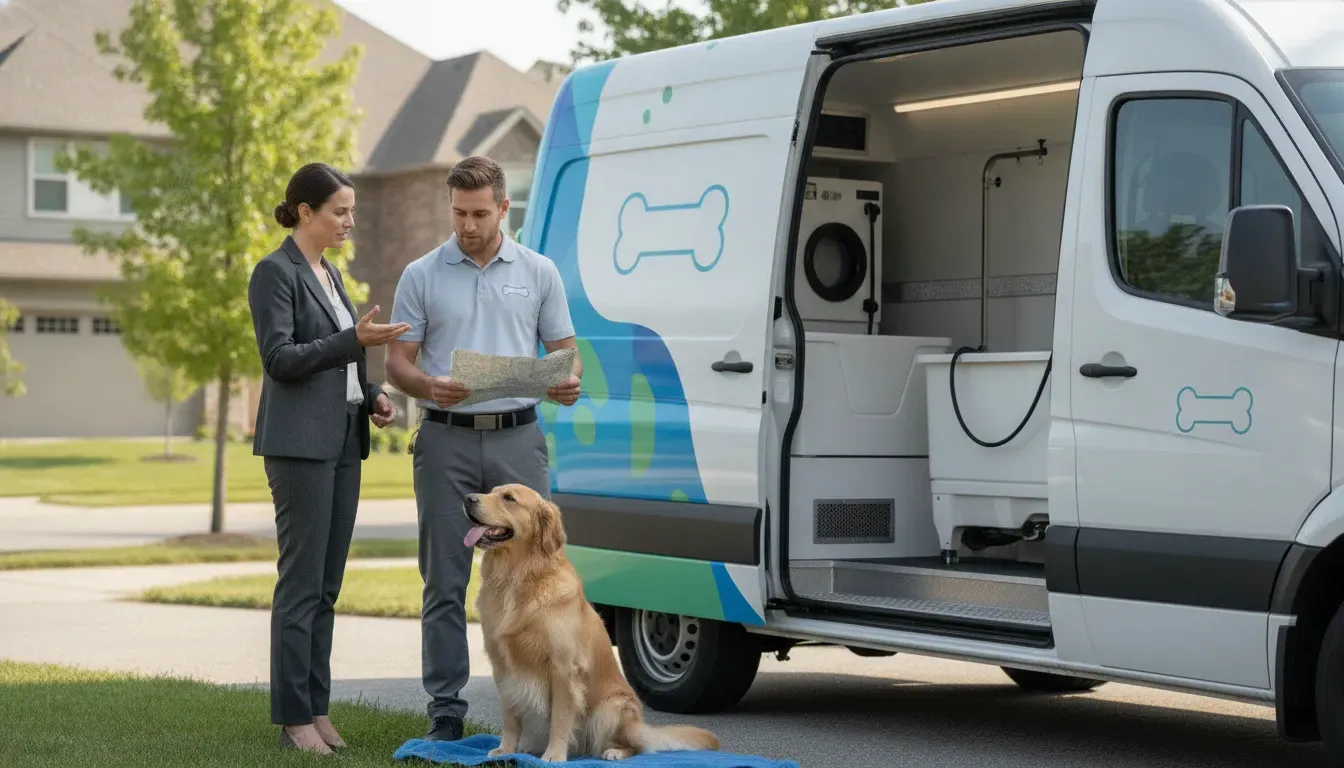
List the roles required before launch and at each growth stage. A first van may require an owner or manager, one or more trained groomers, customer support coverage, and access to maintenance or operational help. Kontota’s support model includes owner operations and leadership training, groomer training at headquarters, and guidance on hiring, customer service, scheduling, safety, pricing, marketing, and business management. Your plan should state what you will learn, what you will hire for, and how you will measure readiness.
Scheduling and route density
Set rules for appointment windows, travel time, service duration, cancellations, weather interruptions, and rebooking. A full calendar is not automatically a healthy route if the van spends too much time moving between customers. Track completed appointments, drive time, rebooking, customer acquisition source, average service value, cancellations, and customer satisfaction.
Van, safety, and quality management
Document preventive maintenance, cleaning, water and power checks, equipment inspection, pet handling, incident response, and quality-control reviews. Safety should be a non-negotiable operating value. A business plan that focuses only on bookings but omits pet safety, employee safety, vehicle readiness, and customer communication is incomplete.
Read the mobile pet grooming franchise operations guide for related planning considerations. Keep your own operations plan specific to the territory and management team you intend to build.
Risk Review and Franchise Due Diligence
Your final business-plan section should turn uncertainty into questions and owners. The Federal Trade Commission explains that the Franchise Rule requires prospective franchisees to receive a disclosure document with 23 categories of information about the franchise, its leadership, and its franchisees. Use the FTC Franchise Rule reference as a general diligence resource, then rely on the current FDD and professional advice for your decision.
Use this checklist before signing:
- Review the current FDD and record follow-up questions for Items 5, 6, 7, 11, 12, 19, and 20.
- Confirm the total investment range, working-capital expectations, recurring fees, renewal terms, and required purchases.
- Validate the proposed territory with the franchisor and test the local demand assumptions independently.
- Speak with current and former franchise owners where permitted, asking about training, support, hiring, route building, and challenges.
- Confirm licensing, insurance, vehicle, employment, animal-care, and local operating requirements with qualified advisers.
- Stress-test the plan for slower hiring, van downtime, lower rebooking, higher maintenance, and a delayed opening.
- Decide what must be true before you proceed and document who will verify each item.
Kontota presents a five-step discovery process: Discovery Call, Territory Analysis, FDD Review, Franchise Validation and Headquarters Meeting, and Franchise Agreement Signature. It is a mutual evaluation, with no pressure or obligation to move forward. Use each step to improve your plan rather than treating the process as a formality.
For a practical overview of the buyer journey, see how to buy a dog grooming franchise. For the cost-specific questions that belong in your model, review the mobile dog grooming franchise cost guide.
Get Started with a No-Pressure Franchise Consultation
Frequently Asked Questions
Do I need grooming experience to open a mobile dog grooming franchise?
No. A franchise owner can focus on leading and developing the business while hiring trained groomers. You still need to understand the operation, manage people, protect safety standards, and use the franchisor’s training and support systems.
What should a mobile dog grooming business plan include?
Include an executive summary, territory and market analysis, customer and competitor research, financial assumptions, staffing and training, van operations, marketing, risk management, and a due-diligence checklist tied to the current FDD.
Can I use a business plan to predict franchise earnings?
A plan can model scenarios, but it cannot guarantee earnings. Use only documented FDD information and clearly labeled assumptions. Any financial performance representation should be reviewed in the applicable FDD Item 19 disclosure.
How do I evaluate a protected franchise territory?
Review the approved boundaries, household and dog-owner data, route density, drive times, competition, customer demand, and expansion rules. Territory availability and protections are specific to the market and current franchise documents.
How soon can a mobile dog grooming franchise open?
Kontota describes an approximately 90-day path from inquiry to opening, subject to the candidate, territory, training, staffing, vehicle, financing, licensing, and other launch requirements. Confirm the current timeline during the discovery process.
What is the next step after completing the plan?
Review the plan with the franchisor, compare it with the current FDD, validate the assumptions with franchise owners and advisers, and schedule a discovery call to discuss territory and fit. A plan should improve your questions before it informs your decision.

